Hardscaping & Pavers in Buckeye, Arizona Built for Durable, Beautiful Outdoor Living
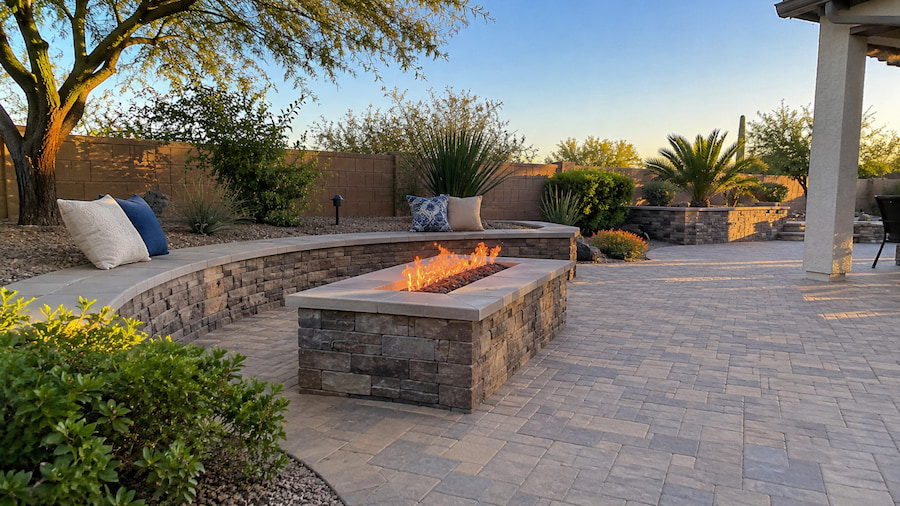
Complete backyard and front yard transformations featuring interlocking concrete pavers, travertine surfaces, masonry seat walls, and desert-friendly outdoor living spaces.
Pricing Provided by Block Guys LLC
Hardscaping is the part of your yard that is not plants. It is the patios, the walkways, the driveways, the seat walls, and the flat surfaces you actually use. In Buckeye, good hardscaping turns a dusty dirt yard into a clean, usable outdoor living space. It gives you a place to put a table, a grill, a fire pit, or a pool chair without sinking into the dirt.
The most common hardscape surface we install is pavers. Pavers are individual concrete or stone units that interlock to form a flexible, crack-resistant surface. Unlike poured concrete, which cracks when the desert soil moves, pavers flex with the ground. If one ever settles or stains, you lift it, fix the base, and put it back. You cannot do that with a concrete slab.
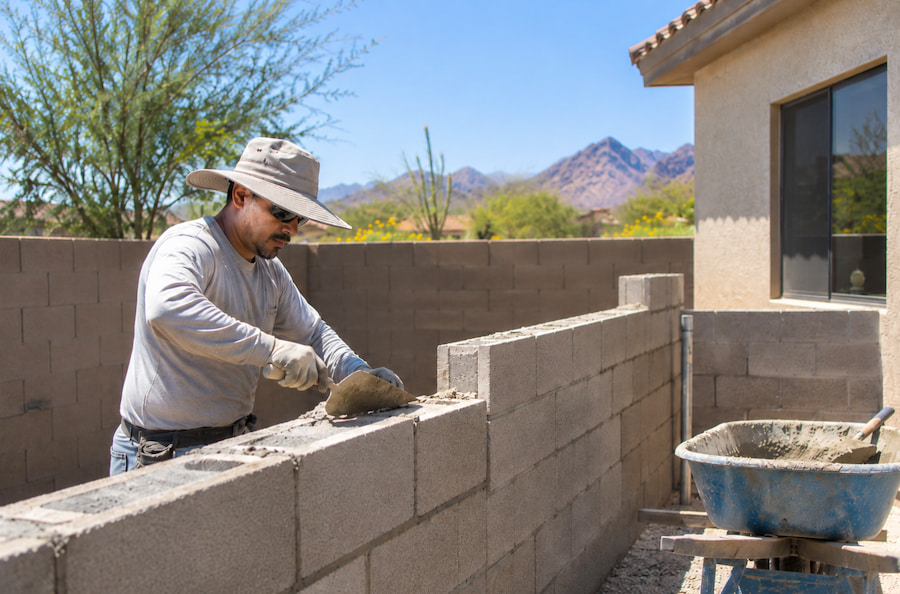
Buckeye Block Wall Contractors designs and installs complete hardscape projects across the West Valley. We handle the excavation, the base, the paver laying, the edge restraints, and the joint sand. We also build the masonry pieces that go with the pavers, like seat walls, planters, and fire pit surrounds, so your whole outdoor space comes together as one cohesive design.
Why Hardscaping & Pavers Matters for Arizona Homeowners
Our dedicated crews in Buckeye, AZ manage every stage of hardscaping & pavers with disciplined planning, premium materials, and adherence to local residential building standards.
Every hardscaping & pavers project we take on in Buckeye and the surrounding West Valley is treated as a complete build, not a quick patch. That means we handle the full scope from the ground up. Excavation, base preparation, structural reinforcement, and the final finish are all part of the same coordinated effort. You are never left coordinating multiple trades or guessing what comes next.
We start by walking your property with you. We listen to what you want the finished wall or outdoor space to accomplish. Then we point out conditions that could affect the build. Desert soil, drainage paths, property slopes, and neighboring structures all factor into how we plan the work. You get a clear explanation of what we will do, why we will do it that way, and what you can expect at each stage.
Materials are selected for Arizona conditions. We use high-strength block, properly graded aggregate base, Grade 60 steel reinforcement, and mortar mixed for hot-weather placement. Nothing is substituted to save a few dollars, because the desert punishes shortcuts. A wall or hardscape built right the first time saves you from costly repairs down the road.
Aggregate Base Compaction,
Interlocking Geometry & Edge Restraints.
Hardscaping in the West Valley requires sub-base stabilization against clay expansion, exact slope grading away from foundations, and commercial-grade paver units.
Excavation to Native Caliche
Stripping unstable desert topsoil down 7 to 9 inches to reach firm, load-bearing strata before building base.
High-Density ABC Aggregate Base
4 to 6 inches of crushed Arizona aggregate compacted with vibratory plates to 95%+ standard Proctor density.
Washed Concrete Bedding Sand
1 inch of screeded ASTM C33 coarse bedding sand that never shifts or washes away under paver joints.
Concrete-Set Edge Restraints
Troweled concrete toe-restraints embedded below grade around all perimeters to prevent lateral creep.
Popular Backyard and Front Yard Hardscaping Projects
Situations where Buckeye homeowners and business owners request this specialized masonry work:
Across Buckeye, Tartesso, Verrado, and the greater West Valley, homeowners and commercial property developers frequently contact our crews when addressing changing property conditions, grade transitions, boundary security requirements, and outdoor living upgrades. Whether resolving steep yard elevation drops, building secure perimeter walls around swimming pools, or renovating weathered surfaces that no longer meet HOA standards, timely professional masonry ensures long-term structural protection.
Every property presents distinct physical demands. We systematically evaluate soil bearing capacity, property boundary pins, neighbor setbacks, and existing utility easements before designing the installation. By addressing underlying earth pressures, storm runoff flows, and local municipal standards up front, we deliver durable masonry and hardscape installations engineered to stand firm for decades.
Why Desert Dirt Yards and Cracked Slabs Need Upgrading
Specific soil, temperature, and atmospheric pressures unique to Maricopa County and the Sonoran Desert:
The Sonoran Desert environment subjects exterior masonry and hardscaping to exceptional physical stress. Extreme summer surface temperatures exceeding 140°F induce rapid thermal expansion across concrete, stone, and mortar assemblies, followed by swift nocturnal cooling that drives cyclic tension cracking. When unreinforced masonry panels lack expansion joints or proper footing embedment, this continuous thermal movement produces progressive joint separation and structural shear fractures.
Subsurface soil dynamics compound these environmental challenges. Buckeye sits on dense caliche hardpan and reactive expansive clays that swell dramatically when saturated by sudden summer monsoon downpours and shrink as they desiccate. Trapped hydrostatic water without engineered gravel backfills and perforated drain outlets multiplies lateral earth pressure behind walls, while unsealed footings experience differential upheaval that causes visible tilting, bowing, and foundation failure.
Buckeye Paver & Hardscape Standards
Built for Arizona outdoor living, our hardscape installations withstand heavy patio furniture and hot summer sun:
98% Base Compaction
Multi-pass mechanical compaction eliminating future settling, ruts, and standing water low-spots.
Polymeric Sand Joint Lock
Activated joint sand hardening into a flexible barrier that blocks weeds, ants, and wind erosion.
8,000+ PSI Concrete Pavers
Ultra-dense manufactured pavers boasting double the compressive strength of standard poured concrete.
1/4" per Foot Slope Drainage
Laser-graded slopes directing 100% of monsoon roof and yard runoff away from home foundations.
Materials & Construction Methods
We refuse to cut corners on sub-grade preparation or mortar quality. Below are the specific materials and engineering methods engineered for long-term structural resilience in desert climates:
Interlocking Paver Bases, Edge Restraints, and Polymeric Sand
Base Compaction
The base is everything in a paver project. We excavate, add Class II aggregate, and compact it in lifts to 95% density. A poorly compacted base is why pavers sink.
Paver Patterns
Herringbone, ashlar, and basketweave each have different interlock strength. Herringbone has the highest horizontal shear resistance, which is why we use it for driveways.
Polymeric Sand
Polymeric sand has a polymer additive that hardens when wet. It locks the pavers together and stops weeds and ants, unlike regular sand that washes out and invites growth.
Edge Restraints
Without a solid edge restraint, the border pavers spread outward over time and the field opens up. We install concrete or spiked plastic restraints on every edge.
How We Design and Build Complete Hardscape Environments
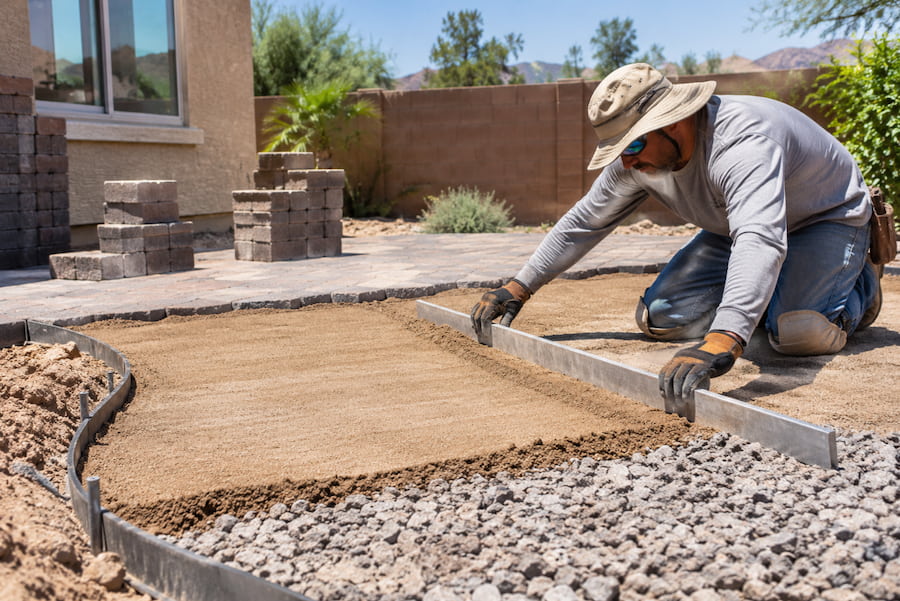
Excavation & Base
Digging 6 to 8 inches and compacting crushed aggregate base.
Bedding Sand
Screeding clean coarse sand for a precision flat plane.
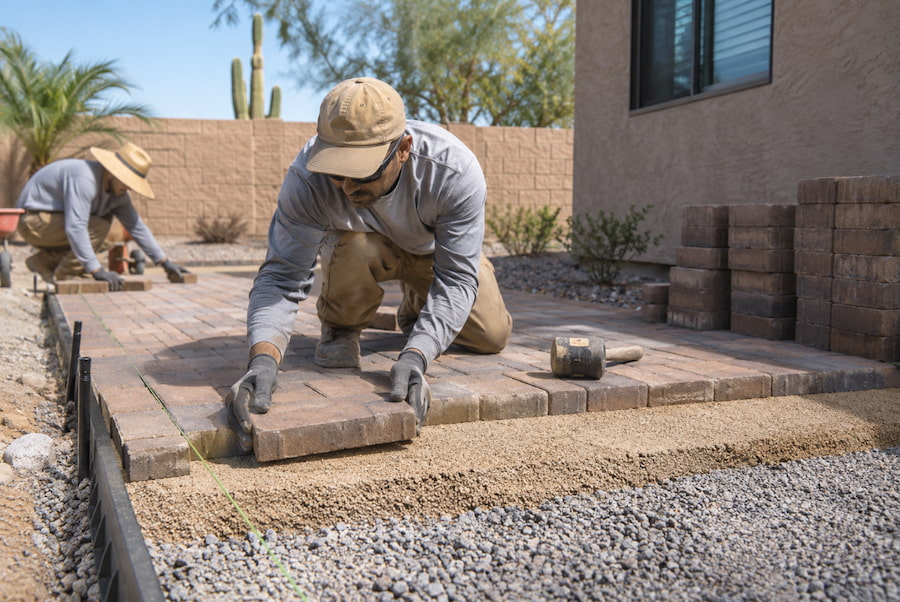
Paver Placement
Hand-laying chosen pattern with diamond saw boundary cuts.
Joint Locking
Sweeping polymeric sand and vibratory compaction locking.
What Homeowners in Buckeye Should Know
Why Pavers Beat Poured Concrete in Arizona
Poured concrete is rigid. The desert soil underneath it is not. When that soil expands and contracts with moisture and temperature, the concrete cannot flex, so it cracks. You have seen this on every older driveway and patio in Buckeye. The cracks start small, grow over time, and collect weeds and water.
Pavers solve this because they are individual units. Each paver can move a tiny amount independently. The joint sand between them flexes. The whole surface acts like a flexible mat instead of a rigid slab. When the ground moves, the pavers move with it instead of cracking. This is why paver driveways and patios last 30 to 50 years while concrete slabs start cracking in 5 to 10.
The other advantage is repairability. If a paver stains, cracks, or settles, you lift that one piece, fix the base, and put it back. The repair is invisible. With concrete, a repair is a visible patch that never quite matches. Over the life of the surface, pavers are both more durable and easier to maintain.
The Base: Where Every Paver Project Succeeds or Fails
You cannot see the base once the pavers are down, but it is the most important part of the job. The base is the layer of compacted crushed aggregate that sits under the bedding sand and the pavers. It carries the load and provides a stable, flat surface. A weak base means settling, dips, and trip hazards within a year or two.
We excavate to the right depth, usually 6 to 8 inches for a patio and 9 to 11 inches for a driveway, to make room for the base. We then add Class II aggregate in lifts, compacting each lift to 95% density with a plate compactor. Skipping the lift compaction is a common shortcut that leads to settling.
On driveways, we go deeper and use geotextile fabric between the subgrade and the base to stop the base from mixing into the native soil. This is the difference between a driveway that holds up to an RV and one that develops tire ruts. The base is not glamorous, but it is the whole game.
Choosing Pavers: Concrete, Travertine, and Patterns
Concrete pavers are the workhorse of hardscaping. They are high-density, available in many colors and shapes, and cost-effective. Modern concrete pavers have a compressive strength over 8,000 PSI, nearly three times that of poured concrete. They come in finishes that mimic natural stone, brick, or clean modern lines.
Travertine is the premium choice, especially for pool decks. Natural travertine in light shades stays dramatically cooler underfoot than concrete, which matters when you are walking to the pool in July. It also has natural texture that makes it slip-resistant when wet. It costs more, but the comfort and look are hard to beat.
The pattern affects both look and strength. Herringbone has the strongest interlock, which is why we use it for driveways. Ashlar and 3-piece modular patterns give a more refined, random look for patios. We help you choose a pattern that fits the space and the way you will use it.
Keeping Weeds and Ants Out of Your Pavers
The old complaint about pavers was that weeds grew in the joints and ants pushed sand up through them. That was true when joints were filled with plain sand. Plain sand washes out, leaves a gap, and invites seeds and insects. Modern polymeric sand has solved this.
Polymeric sand contains a polymer that activates with water and hardens into a flexible, solid joint. Once it sets, weeds cannot germinate in it and ants cannot push through it. The joints stay tight and clean for years. We sweep it in, vibrate the pavers to settle it, and mist it with water to activate the polymer.
A sealed paver surface goes one step further. A penetrating sealer protects the pavers from oil stains, BBQ grease, and UV fading, and it can help hold the joint sand in place. Sealing is optional, but it extends the life and look of the surface, especially on driveways and pool decks.
What Affects Project Cost
Every property has specific physical and geotechnical conditions that dictate final scope and investment. We provide clear, itemized written estimates with zero hidden fees:
Related Concrete & Masonry Services
Why Choose Buckeye Block Wall Contractors
We bring specialized Sonoran Desert construction expertise, transparent project management, and strict compliance with Arizona Registrar of Contractors standards.
Questions About Hardscaping & Pavers in Buckeye, Arizona Built for Durable, Beautiful Outdoor Living
Practical, straightforward answers about costs, permits, repairs, and desert construction.
Q1.Why are pavers better than concrete slabs in Buckeye, AZ?
Pavers are interlocking individual units that flex with Arizona's expansive soils without cracking, unlike rigid concrete slabs that frequently fracture.
Q2.Do weeds grow between pavers in Buckeye, AZ?
When installed with modern polymeric sand, the sand hardens into a durable, flexible polymer that completely prevents weed germination and ant hills.
Q3.How hot do pavers get in Buckeye, AZ summers?
Light-colored travertine and light-toned concrete pavers stay significantly cooler underfoot than dark concrete or asphalt.
Q4.How long does a paver patio last in Buckeye, AZ?
Quality pavers have a compressive strength exceeding 8,000 PSI, nearly three times stronger than poured concrete, and last 30 to 50+ years.
Q5.Can pavers support vehicles in Buckeye, AZ?
Yes, when installed over an 8 to 10-inch compacted aggregate base with 60mm or 80mm vehicular pavers, they support full-size trucks and RVs.
Q6.Do you seal pavers after installation?
We offer optional commercial penetrating sealers that protect pavers against oil stains, BBQ grease, and UV fading.
Q7.How much does hardscaping with pavers cost?
Standard concrete paver installations typically range from $14 to $22 per square foot, while premium travertine ranges from $18 to $28 per square foot.
Q8.Are your contractors licensed for hardscaping?
Yes, we hold Arizona ROC #354592 with full bonding and insurance for all residential and commercial hardscaping.
Ready to Build or Repair Your Hardscaping & Pavers?
Schedule an on-site consultation in Buckeye or anywhere in the West Valley for a clear, itemized proposal.