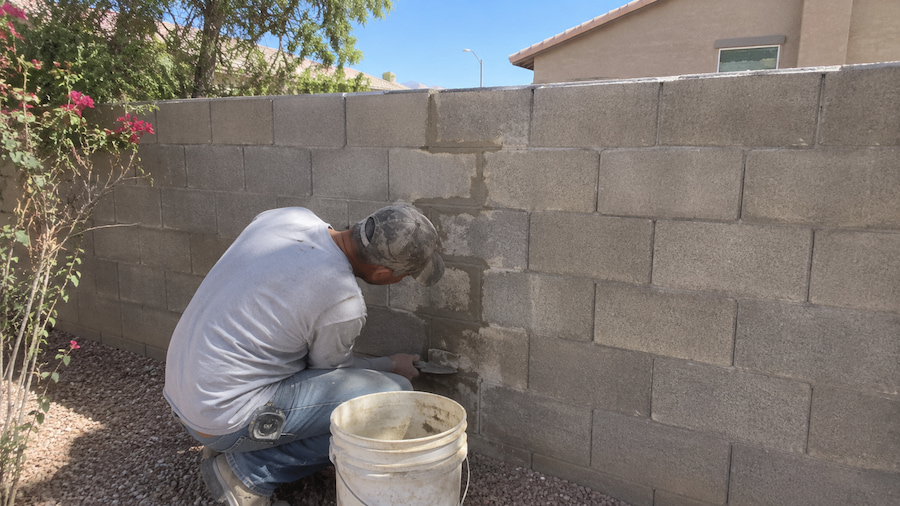
Masonry Repair in Buckeye, Arizona That Fixes Cracks, Loose Block, and Failing Mortar
Restore structural integrity and visual beauty to deteriorated masonry, brick, stone veneer, and mortar joints with expert repairs tailored for Arizona properties.
Pricing Provided by Block Guys LLC
Masonry is one of the most durable building materials there is, but it is not maintenance-free. In Buckeye, the combination of intense sun, monsoon moisture, and soil movement works on masonry over time. Mortar joints crumble. Stone veneer loosens. Cracks open up. White efflorescence blooms on the surface. None of it happens overnight, but left alone, small problems become structural ones.
Masonry repair is about catching those problems early and fixing them right. The most common repair is repointing, which means grinding out the old, decayed mortar from the joints and packing in fresh mortar. It sounds simple, but doing it so the new mortar matches the old in color, strength, and appearance takes real skill. Done wrong, repointing looks worse than the damage and can actually trap water in the wall.
Buckeye Block Wall Contractors repairs masonry across the West Valley. We repoint mortar joints, stitch structural cracks, replace spalling brick and stone, re-attach loose veneer, and stop efflorescence. We match the existing materials so the repair disappears into the wall, and we address the cause so the damage does not come back.
How Masonry Repair Helps Reduce the Risk of Costly Repairs
Our dedicated crews in Buckeye, AZ manage every stage of masonry repair with disciplined planning, premium materials, and adherence to local residential building standards.
Every masonry repair project we take on in Buckeye and the surrounding West Valley is treated as a complete build, not a quick patch. That means we handle the full scope from the ground up. Excavation, base preparation, structural reinforcement, and the final finish are all part of the same coordinated effort. You are never left coordinating multiple trades or guessing what comes next.
We start by walking your property with you. We listen to what you want the finished wall or outdoor space to accomplish. Then we point out conditions that could affect the build. Desert soil, drainage paths, property slopes, and neighboring structures all factor into how we plan the work. You get a clear explanation of what we will do, why we will do it that way, and what you can expect at each stage.
Materials are selected for Arizona conditions. We use high-strength block, properly graded aggregate base, Grade 60 steel reinforcement, and mortar mixed for hot-weather placement. Nothing is substituted to save a few dollars, because the desert punishes shortcuts. A wall or hardscape built right the first time saves you from costly repairs down the road.
Tuckpointing, Salt Spalling Repair,
& Historic & Modern Block Restoration.
Desert heat and irrigation mineral deposits deteriorate mortar joints over time. Our masonry restoration process extracts decayed mortar and injects matching compressive mixes.
Dust-Free Mortar Raking
Diamond blade precision raking removing damaged mortar to a clean 3/4-inch depth without block face gouging.
Hydraulic Lime & Type N/S Blends
Selecting mortar formulations that match the hardness and elasticity of existing masonry units.
Efflorescence & Mineral Desalination
Treating deep-seated calcium and alkali blooms caused by overspray from lawn sprinklers.
Structural Anchor Doweling
Pinning delaminated masonry faces back to parent structures using stainless helical anchors.
Signs of Failing Mortar, Loose Stone, and Damaged Masonry
Situations where Buckeye homeowners and business owners request this specialized masonry work:
Across Buckeye, Tartesso, Verrado, and the greater West Valley, homeowners and commercial property developers frequently contact our crews when addressing changing property conditions, grade transitions, boundary security requirements, and outdoor living upgrades. Whether resolving steep yard elevation drops, building secure perimeter walls around swimming pools, or renovating weathered surfaces that no longer meet HOA standards, timely professional masonry ensures long-term structural protection.
Every property presents distinct physical demands. We systematically evaluate soil bearing capacity, property boundary pins, neighbor setbacks, and existing utility easements before designing the installation. By addressing underlying earth pressures, storm runoff flows, and local municipal standards up front, we deliver durable masonry and hardscape installations engineered to stand firm for decades.
Why Mortar Joints Crumble and Masonry Surfaces Deteriorate
Specific soil, temperature, and atmospheric pressures unique to Maricopa County and the Sonoran Desert:
The Sonoran Desert environment subjects exterior masonry and hardscaping to exceptional physical stress. Extreme summer surface temperatures exceeding 140°F induce rapid thermal expansion across concrete, stone, and mortar assemblies, followed by swift nocturnal cooling that drives cyclic tension cracking. When unreinforced masonry panels lack expansion joints or proper footing embedment, this continuous thermal movement produces progressive joint separation and structural shear fractures.
Subsurface soil dynamics compound these environmental challenges. Buckeye sits on dense caliche hardpan and reactive expansive clays that swell dramatically when saturated by sudden summer monsoon downpours and shrink as they desiccate. Trapped hydrostatic water without engineered gravel backfills and perforated drain outlets multiplies lateral earth pressure behind walls, while unsealed footings experience differential upheaval that causes visible tilting, bowing, and foundation failure.
Buckeye Masonry Repair Standards
Detailed masonry repair protocols restoring structural longevity and original appearance:
Clean 3/4" Mortar Key
Deep uniform raking ensuring new mortar mechanically keys into the block joint permanently.
Compressive Mortar Match
Preventing harder modern mortar from cracking softer legacy blocks under desert expansion.
Concave Weather Joints
Tooling joints with compressed concave profiles that shed monsoon rain instantly.
Siloxane Sealer Finish
Penetrating breathable siloxane waterproofing that prevents future efflorescence leaching.
Materials & Construction Methods
We refuse to cut corners on sub-grade preparation or mortar quality. Below are the specific materials and engineering methods engineered for long-term structural resilience in desert climates:
Tuckpointing, Crack Stitching, and Moisture Control Methods
Tuckpointing & Repointing
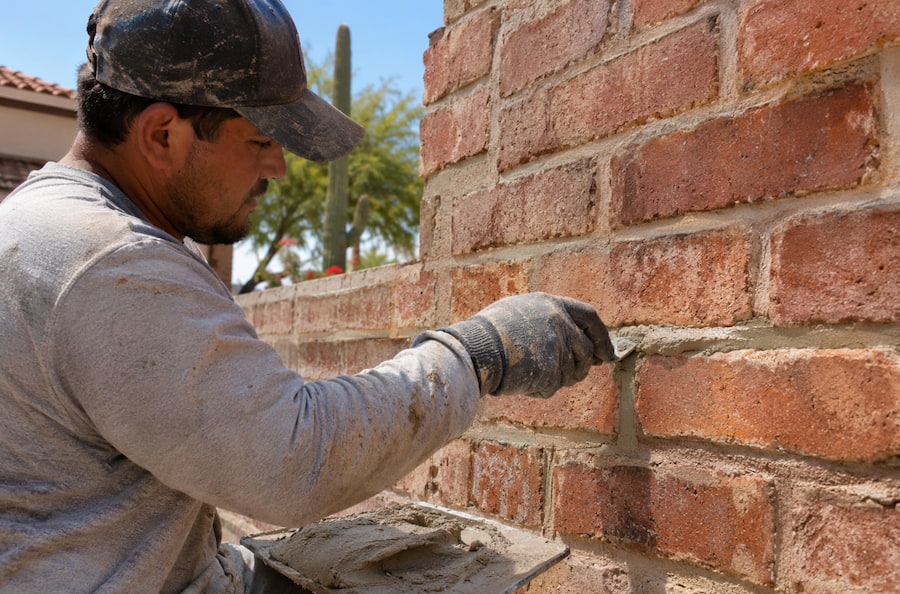
Repointing removes decayed mortar to a uniform depth and packs in fresh, color-matched mortar. It restores the joint's water resistance and the wall's structural bond.
Crack Stitching
Structural cracks are stitched with stainless steel helical bars embedded in epoxy across the crack, tying the masonry back together so the crack cannot reopen.
Efflorescence & Moisture
Efflorescence is mineral salt left by evaporating water. Cleaning it without stopping the moisture source means it returns. We clean, seal, and fix the water source.
Breathable Sealants
Silane/siloxane sealers let water vapor escape the masonry while keeping liquid water out. Non-breathable sealers trap moisture and cause spalling.
Our Tuckpointing and Masonry Repair Process
Joint Raking
Removing damaged mortar to uniform 1/2-inch depth.
Mortar Matching
Custom-blending sand and color pigment for identical match.
Tuckpointing
Hand-packing fresh mortar into joints with striking tools.
Sealing
Applying penetrating breathable sealant to prevent water absorption.
What Homeowners in Buckeye Should Know
Why Mortar Joints Fail in the Arizona Desert
Mortar is the soft, workable material between the hard units of a masonry wall. It is designed to be slightly weaker than the brick or block so that the wall flexes at the joints instead of cracking the units. But mortar takes the brunt of weather. In Buckeye, that means intense UV, monsoon rain, and big temperature swings that make the wall expand and contract every single day.
Over years, that cycle breaks down the mortar. It loses its bond to the stone or block. It crumbles and falls out of the joints. Once the joint is open, water gets in behind the mortar, which accelerates the damage. In winter, the rare freeze-thaw cycles we do get can pop the face off the masonry units, a problem called spalling.
Repointing replaces that decayed mortar with fresh, properly mixed mortar. The key is matching the new mortar to the old. A mortar that is too hard will damage the surrounding masonry. A mortar that is the wrong color looks like a patch. We analyze the existing mortar and match both its properties and its appearance.
Efflorescence: What the White Powder Means
That white, powdery stain on masonry is efflorescence. It is not mold and it is not a defect in the masonry itself. It is a sign that water is moving through the wall. As water travels through the masonry, it dissolves soluble salts in the cement or the stone. When the water reaches the surface and evaporates, it deposits those salts as the white powder you see.
Efflorescence tells you two things. Water is getting into the wall, and the wall is not sealed against it. The water source is usually irrigation overspray, a sprinkler hitting the wall, a crack letting rain in, or poor drainage at the base. Cleaning off the efflorescence without stopping the water means it comes right back.
We handle efflorescence in three steps. We clean the surface with a neutralizing wash to remove the salts. We find and stop the water source. Then we apply a breathable silane/siloxane sealer that keeps liquid water out while letting vapor escape. That stops the efflorescence cycle for good.
Loose Stone Veneer and How We Re-Attach It
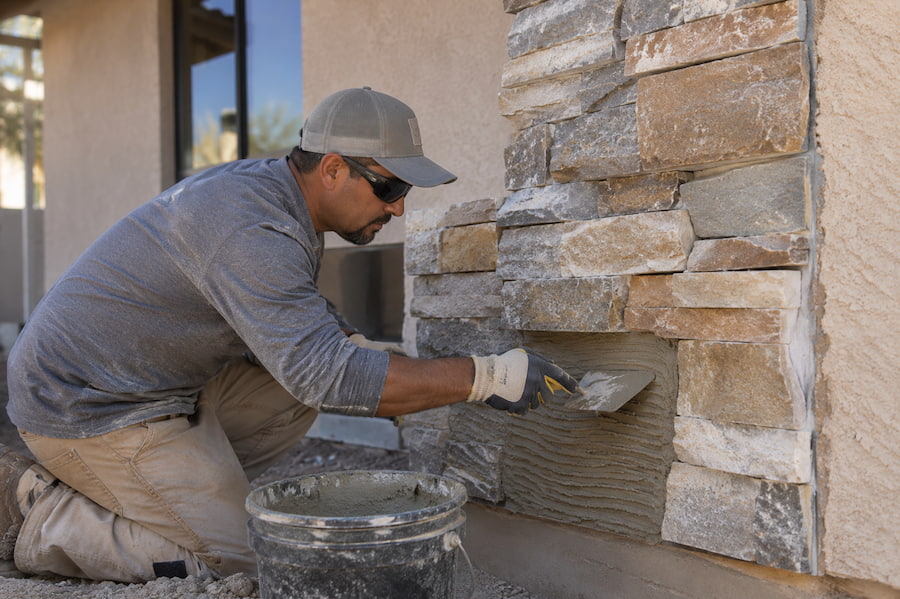
Stone veneer is a thin layer of natural or manufactured stone applied over a wall, a column, or an outdoor kitchen. When it is installed right, it lasts for decades. When it is installed with the wrong adhesive, or without proper prep, it starts to pop off. You will see corners lifting, pieces hanging loose, or stones on the ground beneath the wall.
The usual cause is a bonding failure. The original installer used a standard thinset that could not handle the thermal cycling, or they spot-bonded the stone with dabs of mortar instead of fully back-buttering it. Spot bonding leaves voids behind the stone where water collects and breaks the bond.
We re-attach loose veneer by removing the loose pieces, cleaning the substrate down to sound material, applying a polymer-modified mortar, and fully back-buttering each stone for 100% coverage. The repaired section matches the surrounding stone, and the bond is permanent.
When to Repair and When to Leave It Alone
Not every crack or stain needs immediate repair. Hairline cracks in mortar joints that are not growing are often just normal thermal movement. A small amount of efflorescence that does not recur after cleaning may not need a sealer. We will tell you honestly what needs attention and what is just character.
What does need attention is anything that is getting worse. A crack that widens over time. Mortar that is actively falling out. Veneer that is popping off. Efflorescence that returns after cleaning. These are signs of ongoing damage, and they will only get more expensive to fix the longer they wait.
The cheapest repair is the one you do early. Repointing a few joints costs a fraction of rebuilding a wall that was left until the damage spread. We give free assessments so you know where you stand before it becomes an emergency.
What Affects Project Cost
Every property has specific physical and geotechnical conditions that dictate final scope and investment. We provide clear, itemized written estimates with zero hidden fees:
Related Concrete & Masonry Services
Why Choose Buckeye Block Wall Contractors
We bring specialized Sonoran Desert construction expertise, transparent project management, and strict compliance with Arizona Registrar of Contractors standards.
Questions About Masonry Repair in Buckeye, Arizona That Fixes Cracks, Loose Block, and Failing Mortar
Practical, straightforward answers about costs, permits, repairs, and desert construction.
Q1.What is tuckpointing and why is it needed in Buckeye, AZ?
Tuckpointing is the process of removing decayed, weathered mortar and packing in fresh, high-strength mortar to prevent water intrusion and restore structural bonding.
Q2.Can you match the color of my existing mortar in Buckeye, AZ?
Yes, our masonry craftsmen carefully analyze existing mortar sand grain size and pigment to blend repairs seamlessly.
Q3.Why is white powder forming on my masonry in Buckeye, AZ?
That is efflorescence, soluble mineral salts left behind when moisture evaporates out of porous block or mortar. We clean and seal masonry to stop it.
Q4.What happens if I ignore crumbling mortar joints in Buckeye, AZ?
Neglected joints allow rainwater and desert grit into internal wall cavities, rapidly accelerating structural cracking and risking wall collapse.
Q5.Can you re-attach loose stone veneer on outdoor kitchens in Buckeye, AZ?
Yes, we clean the backing substrate, apply polymer-modified thin-set mortar, and secure the veneer permanently.
Q6.How much does masonry repair cost?
Most residential tuckpointing and crack repairs range between $450 and $1,500 depending on total joint length.
Q7.How long will professional masonry repairs last?
Properly executed repointing with high-grade mortar typically lasts 20 to 30 years.
Q8.Are estimates free for masonry repair?
Yes, we provide free in-person damage assessments and written repair estimates.
Ready to Build or Repair Your Masonry Repair?
Schedule an on-site consultation in Buckeye or anywhere in the West Valley for a clear, itemized proposal.