Stone Retaining Walls in Buckeye, Arizona: Natural Beauty That Holds Back the Desert
Elevate your landscape with authentic natural stone and quarried rock retaining walls. Natural stone provides timeless desert beauty combined with engineered structural stability.
Pricing Provided by Block Guys LLC
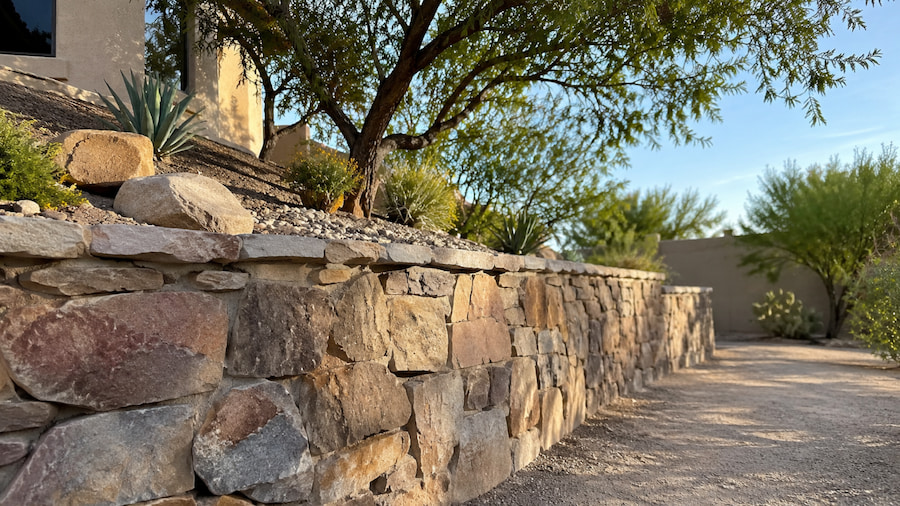
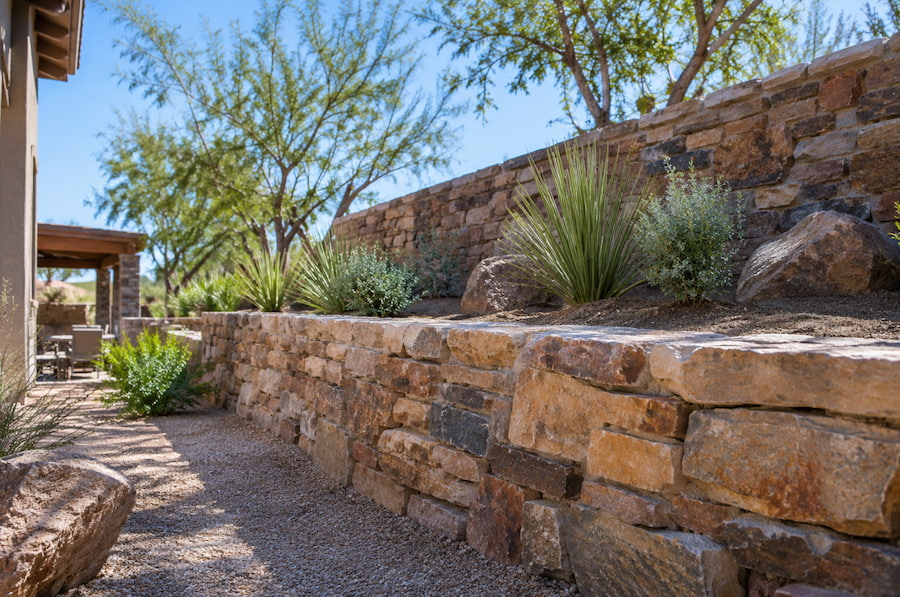
A stone retaining wall gives a Buckeye property something a plain block wall cannot. It brings the look of the natural desert into the yard. Real stone has color variation, texture, and a weight that reads as permanent and crafted. For homeowners who want their landscape to feel like it belongs in Arizona, stone is the finish that does it.
But a stone retaining wall is still a retaining wall. It has to hold back earth, manage water, and stand up to the same forces as any engineered wall. The stone is the face. Behind it, there is still a footing, reinforcement, and drainage doing the structural work. A wall that looks like dry-stacked stone but has no engineering behind it will lean and fail just like any other poorly built wall.
Buckeye Block Wall Contractors builds stone retaining walls two ways. We build full natural stone walls where the stone itself is the structure, and we build engineered CMU walls faced with natural stone, where you get the strength of reinforced block with the look of real rock. We help you choose based on the height, the load, and the aesthetic you want.
The Purpose and Benefits of Stone Retaining Walls in Buckeye
From rustic dry-stacked desert boulders to structural mortared limestone and granite terraces, we craft natural stone retaining systems that harmonize with native Sonoran landscapes.
Every stone retaining walls project we take on in Buckeye and the surrounding West Valley is treated as a complete build, not a quick patch. That means we handle the full scope from the ground up. Excavation, base preparation, structural reinforcement, and the final finish are all part of the same coordinated effort. You are never left coordinating multiple trades or guessing what comes next.
We start by walking your property with you. We listen to what you want the finished wall or outdoor space to accomplish. Then we point out conditions that could affect the build. Desert soil, drainage paths, property slopes, and neighboring structures all factor into how we plan the work. You get a clear explanation of what we will do, why we will do it that way, and what you can expect at each stage.
Materials are selected for Arizona conditions. We use high-strength block, properly graded aggregate base, Grade 60 steel reinforcement, and mortar mixed for hot-weather placement. Nothing is substituted to save a few dollars, because the desert punishes shortcuts. A wall or hardscape built right the first time saves you from costly repairs down the road.
Stacked Boulder Craftsmanship,
Gravity Mass & Natural Desert Drainage.
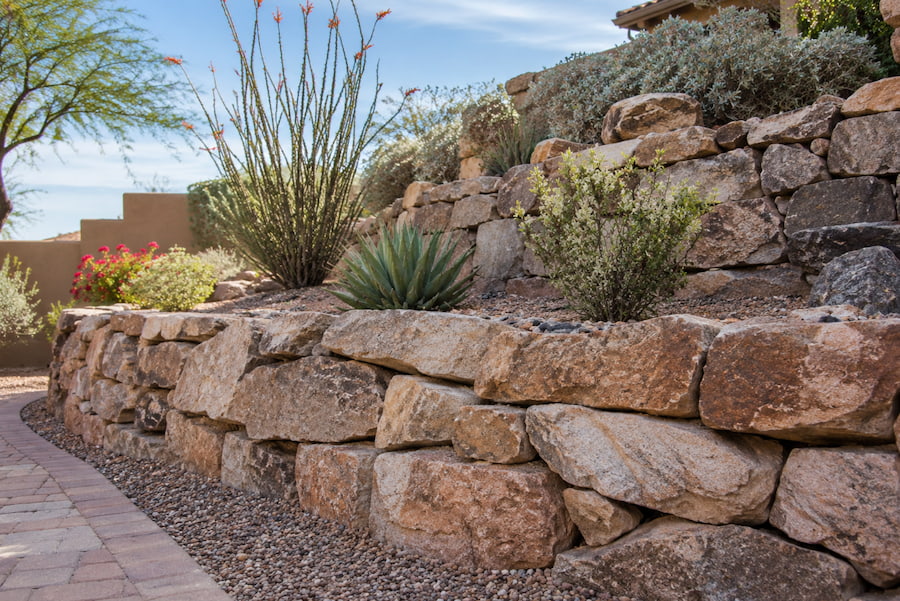
Stone retaining walls combine geological permanence with organic desert aesthetics, using natural mass and precision dry-stack or mortared coursing to retain terrain.
Native Arizona Quarry Selection
Sourcing dense, non-porous granite, schist, and limestone boulders that resist desert spalling and heat fractures.
Gravity Battered Wall Face
Setting stone faces at a backward incline of 1 to 2 inches per vertical foot to utilize gravity as a stabilizing force.
Deep Header & Tie-Back Stones
Interlocking long stone units extending deep into the earth backfill to key the entire assembly into the hillside.
Natural Permeable Interstices
Dry-stacked or weep-mortared joints allowing groundwater to filter harmlessly through without pressure buildup.
Where Natural Stone Retaining Walls Enhance Arizona Landscapes
Situations where Buckeye homeowners and business owners request this specialized masonry work:
Across Buckeye, Tartesso, Verrado, and the greater West Valley, homeowners and commercial property developers frequently contact our crews when addressing changing property conditions, grade transitions, boundary security requirements, and outdoor living upgrades. Whether resolving steep yard elevation drops, building secure perimeter walls around swimming pools, or renovating weathered surfaces that no longer meet HOA standards, timely professional masonry ensures long-term structural protection.
Every property presents distinct physical demands. We systematically evaluate soil bearing capacity, property boundary pins, neighbor setbacks, and existing utility easements before designing the installation. By addressing underlying earth pressures, storm runoff flows, and local municipal standards up front, we deliver durable masonry and hardscape installations engineered to stand firm for decades.
Why Unengineered Stone Walls Shift and Collapse Over Time
Specific soil, temperature, and atmospheric pressures unique to Maricopa County and the Sonoran Desert:
The Sonoran Desert environment subjects exterior masonry and hardscaping to exceptional physical stress. Extreme summer surface temperatures exceeding 140°F induce rapid thermal expansion across concrete, stone, and mortar assemblies, followed by swift nocturnal cooling that drives cyclic tension cracking. When unreinforced masonry panels lack expansion joints or proper footing embedment, this continuous thermal movement produces progressive joint separation and structural shear fractures.
Subsurface soil dynamics compound these environmental challenges. Buckeye sits on dense caliche hardpan and reactive expansive clays that swell dramatically when saturated by sudden summer monsoon downpours and shrink as they desiccate. Trapped hydrostatic water without engineered gravel backfills and perforated drain outlets multiplies lateral earth pressure behind walls, while unsealed footings experience differential upheaval that causes visible tilting, bowing, and foundation failure.
Stone Retaining Wall Standards
Crafted with heavy regional stone to deliver decades of slope stability and architectural beauty:
Heavy Tonnage Gravity Mass
Massive base stones creating a stable anchor footprint capable of resisting severe grade thrust.
Crushed Rock Drainage Core
Angled angular aggregate compacted directly behind the stone face for rapid hydrostatic relief.
Interlocking Joint Placement
Every stone set across two lower stones to eliminate continuous vertical joints that invite failure.
Native Desert Plant Integration
Optional planting pockets integrated into stone ledges for desert agave, sage, and trailing succulents.
Stone Selections, Mortar & Drainage Systems
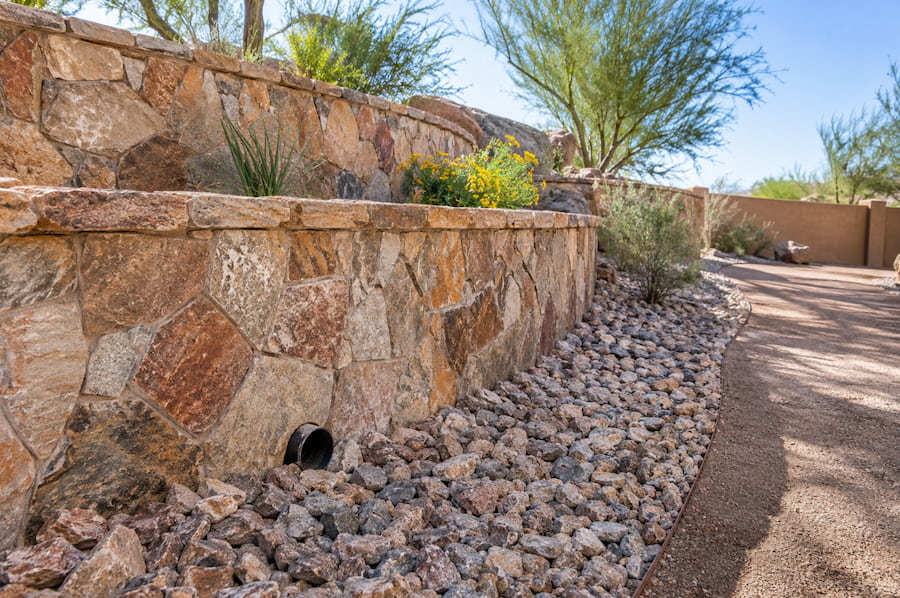
We quarry and select regionally authentic Arizona fieldstone, granite boulders, and malapai basalt, combined with crushed aggregate drainage layers to relieve hydrostatic pressure naturally.
Boulder Placement, Mortared Stone Cores, and Drainage Backfill
Gravity Wall vs. Engineered Core
A dry-stack gravity stone wall relies on the weight of the stones to hold back earth. It works for shorter walls. Taller walls use a reinforced CMU core faced with stone, so the structure does the engineering and the stone does the beauty.
Batter and Interlock
Stone walls lean slightly back into the hill, called batter, so gravity pushes them into the slope instead of away. Each stone must interlock with its neighbors so the wall acts as one mass.
Drainage Behind Stone
Stone walls are not waterproof. Water flows through the joints. We install drainage behind the wall so that flow is controlled and directed, not trapped against the footing.
Stone Selection & Sourcing
We source native Arizona stone so the wall looks like it belongs in the desert. Malapai basalt, fieldstone, and Sedona red sandstone each give a different color and texture.
How We Excavate, Stack, and Anchor Natural Stone Walls
Stone Selection
Choosing complementary stone color, thickness, and texture.
Trench & Foundation
Compacting heavy aggregate base or pouring concrete footing.
Hand-Crafted Setting
Chiseling and setting each stone with structural mortar.
Drainage Backfill
Placing washed crushed stone and continuous drainage pipes.
Building Lasting Stone Retaining Walls in Arizona
The Two Ways to Build a Stone Retaining Wall
There are two fundamentally different approaches to a stone retaining wall, and the right one depends on what the wall needs to do. The first is a full natural stone wall, where the stones themselves are the structure. This works for shorter walls, usually under 3 to 4 feet, where the weight of the stone can hold back the earth by gravity alone. These can be mortared or dry-stacked.
The second approach is an engineered CMU wall faced with natural stone. We build a reinforced, solid-grouted block wall with proper footings and drainage, then face it with full-thickness natural stone. This is how we build taller stone walls, walls with surcharges, and walls that need to meet permit requirements. You get the engineered strength of block and the authentic look of real stone.
Both approaches need the same thing underneath. A proper footing, stable bearing material, and drainage. The stone is what you see. The engineering is what makes it stand for decades.
Why Native Arizona Stone Looks Right in a Buckeye Yard
Stone that comes from somewhere else often looks wrong in an Arizona landscape. The color, the texture, and the scale do not match the natural desert. Native Arizona stone, like malapai basalt, fieldstone, and Sedona red sandstone, has the warm tones and rough textures that match the surrounding desert. A wall built from it looks like it grew there.
Malapai basalt is a dark, volcanic stone with a weathered surface. Fieldstone is a mix of rounded desert stones in warm browns and tans. Sedona red sandstone brings the famous red-orange of northern Arizona. Each gives a different look, and we bring samples so you can see them against your home and landscape before deciding.
Using native stone also makes sense for cost and availability. Imported stone has to travel, which adds to the price. Local stone is quarried here, so it is more available and often more affordable for the same visual impact.
Dry-Stack vs. Mortared Stone: What Lasts Better
A dry-stack stone wall has no mortar between the stones. It relies entirely on the weight and interlock of the stones to stay together. Done well, with proper batter and tightly fitted stones, a dry-stack wall can last for generations. It also drains naturally through the joints, which is an advantage for a retaining wall.
A mortared stone wall uses mortar between the stones to lock them in place. It can be built taller and more precisely than a dry-stack wall, and it holds a cleaner, more formal line. The trade-off is that a mortared wall needs drainage behind it, because water cannot flow through the joints as easily.
For taller walls or walls that need to meet engineering requirements, we often build a CMU core and face it with mortared natural stone. That gives the cleanest look and the strongest structure. For a shorter landscape wall where a natural, rustic look is the goal, dry-stack is a beautiful choice. We help you pick based on the wall's job and your taste.
Drainage and the Stone Wall: Water Still Wins
It is easy to assume a stone wall does not need drainage because water can flow through the joints. For a dry-stack wall, that is partly true. But for a mortared stone wall, or a CMU core faced with stone, water still builds up behind the wall and needs a way out. Trapped water pushes against the wall just as hard as it does against a block wall.
We install the same drainage system behind a stone retaining wall as we do behind any engineered wall. A perforated pipe in washed crushed stone, wrapped in geotextile, carries water away from the back of the wall. For dry-stack walls, we still prepare the base and the backfill so water moves through and away, not into the footing.
The lesson is the same for every retaining wall. Water is the enemy. Whether the wall is block, stone, or anything else, the drainage behind it is what decides whether it stands or fails. We never skip it.
Factors Influencing Stone Retaining Wall Pricing
Stone quarry material choice, crane or heavy machinery access for large boulder placement, hand-chiseling labor, and slope tiering requirements drive final project costs:
Related Concrete & Masonry Services
Why Choose Our Artisan Stonework in Buckeye, AZ
Natural stone masonry requires an experienced eye for balance, weight distribution, and soil mechanics. Our stone masons build rugged terraces that endure for generations.
Frequently Asked Questions About Stone Retaining Walls in Buckeye, AZ
Practical, straightforward answers about costs, permits, repairs, and desert construction.
Q1.What types of stone do you use for retaining walls in Buckeye, AZ?
We build with native Arizona malapai, surface fieldstone, Sedona red sandstone, granite rip-rap, and stacked slate.
Q2.Is a stone retaining wall as strong as a block retaining wall in Buckeye, AZ?
Yes. In fact, many stone walls are built with a solid-grouted, rebar-reinforced concrete CMU structural core that is then faced with full-thickness natural stone.
Q3.Do stone retaining walls require drainage in Buckeye, AZ?
Yes, all retaining walls holding earth require continuous perforated drain tile and crushed drainage stone to prevent water pressure buildup.
Q4.How high can a stone retaining wall be built in Buckeye, AZ?
Gravity stone walls typically reach 3 to 4 feet, while engineered stone walls with concrete cores can exceed 6 feet with proper municipal permits.
Q5.How long does a natural stone retaining wall last in Buckeye, AZ?
Natural stone is virtually indestructible and easily lasts 50 to 100+ years in the Arizona desert climate.
Q6.Can you build curved stone retaining walls?
Yes, natural stone is ideal for building graceful radius curves that follow natural property contours.
Q7.How much does a stone retaining wall cost?
Natural stone retaining walls generally range from $220 to $450 per linear foot installed depending on stone type and height.
Q8.Do you provide free estimates for stone retaining walls?
Yes, we provide free on-site consultations with material samples and itemized written proposals.
Ready to Build or Repair Your Stone Retaining Walls?
Schedule an on-site consultation in Buckeye or anywhere in the West Valley for a clear, itemized proposal.