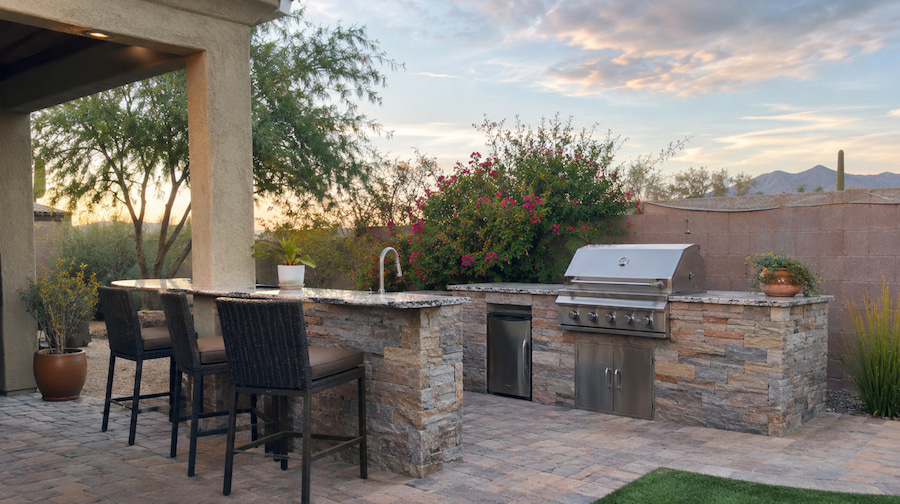
Outdoor Kitchen Construction in Buckeye, Arizona for Backyard Cooking and Gatherings
Transform your patio into a premier desert culinary retreat. We build durable concrete block outdoor kitchens, BBQ islands, bar seating, and stainless appliance cutouts.
Pricing Provided by Block Guys LLC
An outdoor kitchen in the Arizona desert is more than just a grill on a patio. It is the social center of your backyard for eight months of the year, from crisp fall football weekends to spring barbecues and summer evening pool gatherings. But desert conditions are brutal on flimsy, prefabricated outdoor cooking stations. Direct desert sun, surface temperatures topping 150°F, blowing dust, and sudden monsoon deluges will quickly warp, rust, and ruin thin sheet-metal or wood-framed barbecue islands.
That is why custom concrete block (CMU) masonry is the gold standard for outdoor kitchens in Buckeye. Built on an engineered, steel-reinforced concrete footing, our masonry kitchens will never rot, warp, burn, or rust. The solid concrete block core provides structural mass that holds up under heavy granite countertops, handles intense grill heat, and stands up to decades of desert weather without degrading.
Whether you envision a sleek linear grill island with bar seating, an expansive L-shaped culinary suite with outdoor pizza oven and beverage coolers, or a full outdoor kitchen integrated with matching stucco and stacked stone veneer, Buckeye Block Wall Contractors delivers complete, turn-key masonry builds tailored to your backyard lifestyle.
How Outdoor Kitchen Construction Helps Protect Your Investment
Our masonry artisans pour reinforced slabs, erect heat-resistant CMU structural islands, wire utility conduits, and apply custom stone finishes for ultimate desert entertaining.
Every outdoor kitchen construction project we take on in Buckeye and the surrounding West Valley is treated as a complete build, not a quick patch. That means we handle the full scope from the ground up. Excavation, base preparation, structural reinforcement, and the final finish are all part of the same coordinated effort. You are never left coordinating multiple trades or guessing what comes next.
We start by walking your property with you. We listen to what you want the finished wall or outdoor space to accomplish. Then we point out conditions that could affect the build. Desert soil, drainage paths, property slopes, and neighboring structures all factor into how we plan the work. You get a clear explanation of what we will do, why we will do it that way, and what you can expect at each stage.
Materials are selected for Arizona conditions. We use high-strength block, properly graded aggregate base, Grade 60 steel reinforcement, and mortar mixed for hot-weather placement. Nothing is substituted to save a few dollars, because the desert punishes shortcuts. A wall or hardscape built right the first time saves you from costly repairs down the road.
Reinforced CMU BBQ Islands,
Utility Sleeves & Granite Counter Prep.
Custom outdoor kitchens require engineered block structures capable of supporting heavy granite or concrete countertops, stainless steel grill inserts, and integrated gas/electric utilities.
Solid Concrete Island Footings
Monolithic reinforced slabs isolating kitchen structures from ground movement to prevent countertop cracks.
Precision CMU Core Framework
Concrete block walls cut and laid with custom cutouts for grills, side burners, access doors, and bar fridges.
Plumbing, Gas & Electrical Sleeving
Embedding UL-approved conduit and gas line sleeves through block cells prior to solid core filling.
Cantilevered Bar Top Support
Steel corbels and rebar bond beams engineered to support oversized overhanging bar dining counters.
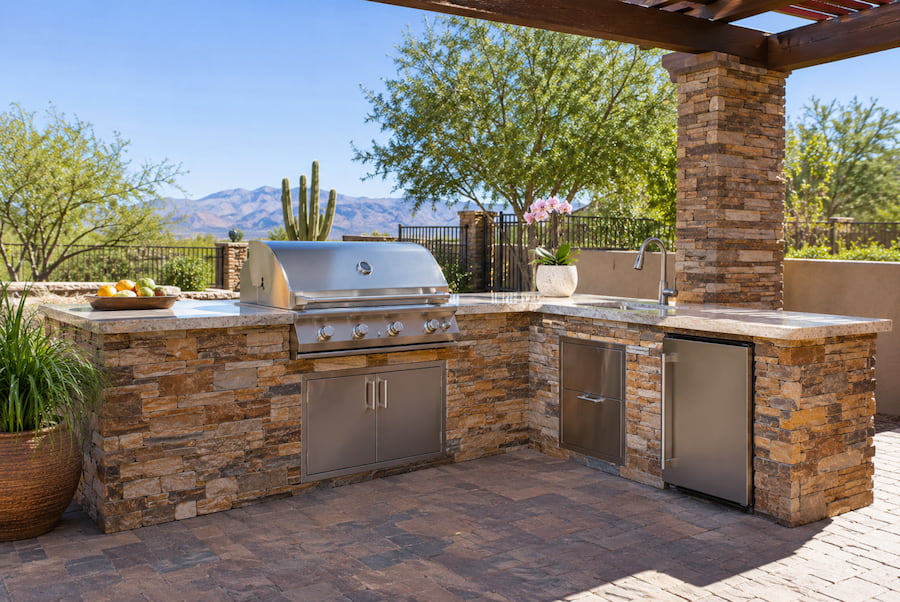
Creating Custom Outdoor Kitchens for Desert Cooking and Entertaining
Situations where Buckeye homeowners and business owners request this specialized masonry work:
Across Buckeye, Tartesso, Verrado, and the greater West Valley, homeowners and commercial property developers frequently contact our crews when addressing changing property conditions, grade transitions, boundary security requirements, and outdoor living upgrades. Whether resolving steep yard elevation drops, building secure perimeter walls around swimming pools, or renovating weathered surfaces that no longer meet HOA standards, timely professional masonry ensures long-term structural protection.
Every property presents distinct physical demands. We systematically evaluate soil bearing capacity, property boundary pins, neighbor setbacks, and existing utility easements before designing the installation. By addressing underlying earth pressures, storm runoff flows, and local municipal standards up front, we deliver durable masonry and hardscape installations engineered to stand firm for decades.
Why Sheet-Metal BBQ Islands Rust While Masonry Kitchens Last
Specific soil, temperature, and atmospheric pressures unique to Maricopa County and the Sonoran Desert:
The Sonoran Desert environment subjects exterior masonry and hardscaping to exceptional physical stress. Extreme summer surface temperatures exceeding 140°F induce rapid thermal expansion across concrete, stone, and mortar assemblies, followed by swift nocturnal cooling that drives cyclic tension cracking. When unreinforced masonry panels lack expansion joints or proper footing embedment, this continuous thermal movement produces progressive joint separation and structural shear fractures.
Subsurface soil dynamics compound these environmental challenges. Buckeye sits on dense caliche hardpan and reactive expansive clays that swell dramatically when saturated by sudden summer monsoon downpours and shrink as they desiccate. Trapped hydrostatic water without engineered gravel backfills and perforated drain outlets multiplies lateral earth pressure behind walls, while unsealed footings experience differential upheaval that causes visible tilting, bowing, and foundation failure.
Outdoor Kitchen Masonry Standards
Crafted for ultimate backyard entertaining with commercial heat insulation and structural permanence:
Insulated Grill Heat Jackets
Thermal protection sleeves shielding masonry and internal components from 60,000+ BTU grill fires.
Heavy Counter Support Rating
Solid-grouted CMU cores capable of carrying 1,500+ lbs of heavy quartz, granite, or poured concrete.
GFCI & Gas Code Compliance
Ventilated island cavities meeting strict Buckeye fire and safety codes for outdoor gas appliances.
Seamless Veneer & Stucco
Exterior finishes matched exactly to the home's main stucco texture or stacked stone accents.
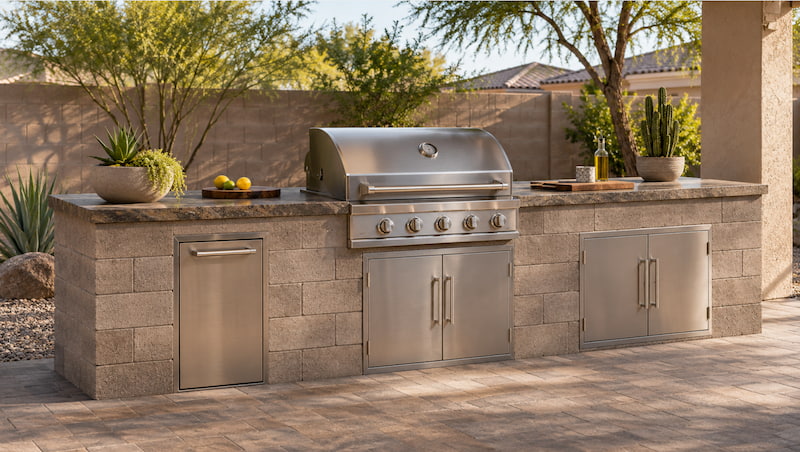
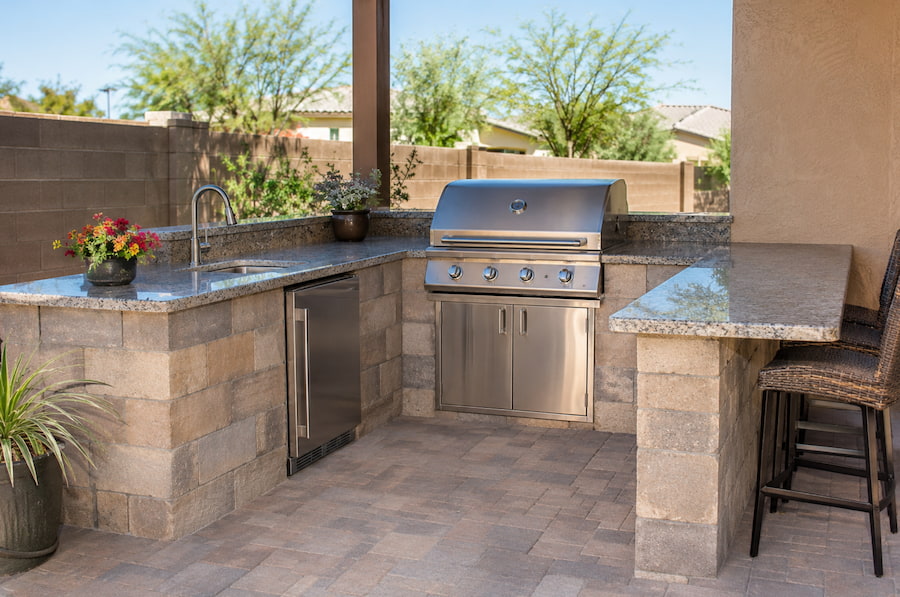
Clean linear CMU block island engineered for standard backyard patios. Features 36-inch built-in gas grill cutout, dual stainless access doors, dedicated trash pullout, and leathered desert granite prep space.
Island Masonry, Natural Stone & Counter Surfaces
We use ASTM Grade N block framing, refractory mortar, 304 stainless appliance cutouts, and polished granite or concrete countertops that stay durable under 115+ degree Arizona sun.
Concrete Block Counter Framing, Refractory Mortars, and Appliance Cutouts
Solid CMU Framing vs. Steel Studs
Prefabricated metal stud islands rust and twist under heavy stone counters. Solid concrete block construction creates a permanent, non-combustible structure that never rots or warps.
Dedicated Ventilation & Gas Relief
Propane is heavier than air and pools at low points. We install low and high louvered stainless vents in every appliance bay to prevent hazardous gas pocket accumulation.
Reinforced Monolithic Concrete Pad
A custom BBQ island weighs thousands of pounds with stone counters. We pour a 4-to-6 inch steel rebar-reinforced pad to prevent cracking and structural settling.
Insulated Grill Jackets & Heat Barriers
High-BTU drop-in gas grills generate intense radiant heat. We integrate insulated jackets and thermal breaks so adjacent cabinets and stone facades never crack from heat fatigue.
From Slab to Stone Veneer: Building Your Custom Outdoor Kitchen
Design & Footing
Determining island shape (L-shape, straight, U-shape) and pouring pad.
Masonry Framing
Laying concrete block with structural mortar and appliance lintels.
Utility Routing
Installing gas lines, electrical conduit, and vent panels.
Veneer & Counter
Applying stone veneer or stucco and setting granite slabs.
Building Lasting Outdoor Kitchens in the Arizona Desert
Why Solid Concrete Block Outlasts Prefabricated Metal Islands
Many homeowners are tempted by prefabricated sheet-metal and cement-board barbecue islands sold at big-box retailers. Unfortunately, these units are fundamentally unsuited to the Sonoran Desert. Thin galvanized studs corrode when monsoon rainwater seeps behind joints, while seasonal temperature swings between 30°F winter nights and 115°F summer afternoons cause metal framing to expand and contract at different rates than the stone facing. Within just three to five years, joints crack, doors sag, and tiles pop off.
In contrast, concrete block (CMU) masonry is fully monolithic with your patio footing. The thermal mass of concrete masonry absorbs and radiates heat evenly without distorting. Termites, rodents, and desert moisture cannot penetrate the masonry core, and because concrete block is completely non-combustible, it provides the safest possible housing for high-BTU gas cooking equipment.
Countertop Materials That Survive Desert Sun and Heat
Selecting the right outdoor countertop material in Buckeye requires balancing beauty with thermal resilience. Standard indoor quartz countertops contain polymer resins that discolor and degrade under intense Arizona ultraviolet (UV) radiation. We recommend materials specifically proven in desert environments.
Natural granite with a honed or leathered finish is our top recommendation. Natural granite is formed under volcanic heat and pressure, so it easily tolerates blazing summer sun, hot pots straight off the grill, and heavy use without fading or scorching. Poured-in-place concrete countertops sealed with food-grade UV-stable penetrants offer an industrial desert aesthetic with custom molded drainboards and cantilevered bar seating.
Utility Sleeving: Natural Gas, Dedicated Electrical & Plumbing
An exceptional outdoor kitchen requires careful coordination of underground utilities before a single block is laid. We dig utility trenches and install code-compliant PVC sleeves for natural gas or propane lines, 20-amp GFCI electrical circuits, and water supply/drain lines.
Having dedicated electrical circuits ensures your outdoor refrigerator, rotisserie motor, ice maker, and low-voltage under-counter LED strip lighting run safely without tripping breaker panels. Every gas connection is installed with accessible emergency quarter-turn shutoff valves located in stainless access bays.
Finishing Your Outdoor Kitchen to Match Your Buckeye Home
An outdoor kitchen should look like a natural architectural extension of your residence, not an afterthought dropped on the patio. Our craftsmen match your home's exact exterior finish, whether that is a Santa Barbara smooth troweled stucco, custom lace texture, or rich stacked stone veneer.
By coordinating the stone color palette with your existing patio pavers, pool coping, or perimeter block walls, we create a unified, resort-style backyard environment that significantly enhances your property's appraisal value and everyday enjoyment.
Factors Influencing Outdoor Kitchen Costs in Buckeye
Island linear footage, appliance packages, natural gas and electrical trenching distances, and stone veneer selections shape final project investment:
Related Concrete & Masonry Services
Why Choose Us for Your Outdoor Kitchen in Buckeye
Unlike flimsy prefabricated sheet-metal islands that rust or warp, our concrete masonry unit kitchens are permanently anchored to reinforced footings.
Frequently Asked Questions About Outdoor Kitchens in Buckeye, AZ
Practical, straightforward answers about costs, permits, repairs, and desert construction.
Q1.Why is concrete block better than metal stud BBQ islands in Buckeye, AZ?
Concrete block masonry is completely non-combustible, impervious to desert rodents, will never rust, and easily lasts 50+ years outdoors.
Q2.Do you run gas and electrical lines for outdoor kitchens in Buckeye, AZ?
Yes, we coordinate all necessary natural gas, electrical GFCI circuits, and water lines according to Buckeye municipal codes.
Q3.What is the best countertop for an outdoor kitchen in Buckeye, AZ?
Natural granite with a honed or leathered finish is the most heat-resistant, UV-stable, and durable countertop material for Arizona summers.
Q4.How much does a custom outdoor kitchen cost in Buckeye, AZ?
Masonry outdoor kitchens typically range from $6,500 for compact 8-foot BBQ islands up to $18,000+ for large L-shaped entertaining kitchens with full appliances.
Q5.Can you match my outdoor kitchen to my house in Buckeye, AZ?
Yes, we color-match your home's exterior stucco or install complementary stacked stone veneer.
Q6.How long does it take to build an outdoor kitchen?
Most custom masonry outdoor kitchen builds take between 1 and 2 weeks from footing to final appliance fitment.
Q7.Do outdoor kitchens require permits?
Running new underground electrical and natural gas lines typically requires municipal trade permits, which we handle completely.
Q8.Can I provide my own grill and appliances?
Yes, we build custom CMU block cutouts to the exact manufacturer specification sheets of any grill or component you purchase.
Ready to Build or Repair Your Outdoor Kitchen Construction?
Schedule an on-site consultation in Buckeye or anywhere in the West Valley for a clear, itemized proposal.