
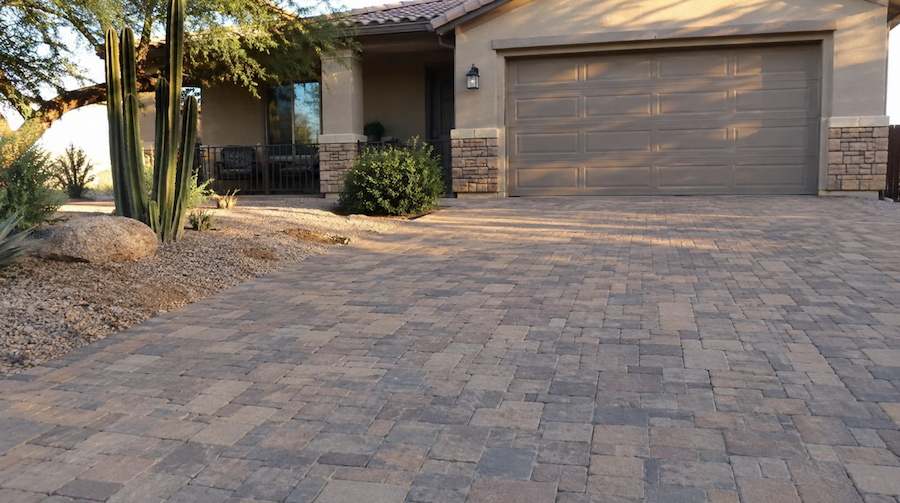
Paver Driveway Installation in Buckeye, Arizona for a Stronger, Better-Looking Entrance
Heavy-vehicular rated interlocking paver driveways built on deep compacted bases with locked edge restraints. A driveway that handles Arizona sun, heavy trucks, and RVs without cracking.
Pricing Provided by Block Guys LLC
A driveway takes more abuse than any other paved surface on your property. It carries the weight of cars, trucks, and RVs every day. It sits in full sun all summer. It gets soaked in monsoon rains. And in Buckeye, it also has to deal with caliche soil underneath that can shift and settle. A driveway that is not built for all of that will crack, sink, and fail.
Concrete driveways crack. It is not a question of if, but when. They crack from soil movement, from heat expansion, from heavy loads, and from the natural curing process. Once a concrete driveway cracks, you are stuck with the cracks. You can patch them, but they come back. You can resurface, but that is temporary. The cracks are there forever.
Paver driveways solve this. Interlocking pavers are individual units, so they flex with the ground instead of cracking. If one paver does settle or stain, you can lift it, fix the base, and put it back. The driveway stays looking new for decades. And the look is premium. A paver driveway gives your home a high-end, finished entrance that concrete cannot match.
Buckeye Block Wall Contractors installs paver driveways across the West Valley. We build them right, with a deep base, proper compaction, locked edge restraints, and the right paver for the load. The result is a driveway that looks great, handles heavy vehicles, and lasts.
What Makes Paver Driveway Installation Worth Considering for Your Property?
Our crews excavate deep subgrades, install 8-to-10 inch compacted aggregate road base, set heavy-gauge vehicular pavers, and lock all edges with reinforced concrete soldier courses.
Every paver driveway installation project we take on in Buckeye and the surrounding West Valley is treated as a complete build, not a quick patch. That means we handle the full scope from the ground up. Excavation, base preparation, structural reinforcement, and the final finish are all part of the same coordinated effort. You are never left coordinating multiple trades or guessing what comes next.
We start by walking your property with you. We listen to what you want the finished wall or outdoor space to accomplish. Then we point out conditions that could affect the build. Desert soil, drainage paths, property slopes, and neighboring structures all factor into how we plan the work. You get a clear explanation of what we will do, why we will do it that way, and what you can expect at each stage.
Materials are selected for Arizona conditions. We use high-strength block, properly graded aggregate base, Grade 60 steel reinforcement, and mortar mixed for hot-weather placement. Nothing is substituted to save a few dollars, because the desert punishes shortcuts. A wall or hardscape built right the first time saves you from costly repairs down the road.
Heavy Axle Load Engineering,
80mm Paver Thickness & Geotextile Base.
Paver driveways handle intense vehicular tire loads, delivery trucks, and RV parking. We engineer heavy 80mm interlocking units over deep compacted crushed rock bases.
8–10" Heavy Aggregate Base
Commercial-grade base depth compacted in 3-inch lifts to support vehicle point loads without rutting.
Heavy-Duty 80mm Commercial Pavers
3-1/8" thick pavers offering 10,000+ PSI compressive strength designed specifically for vehicular driveways.
High-Strength Woven Geotextile
Heavy separation fabric laid between native clay and aggregate to prevent sub-base contamination.
Reinforced Concrete Curb Edging
Sub-surface concrete curb barriers cast along driveway edges to resist tire-turn spreading forces.
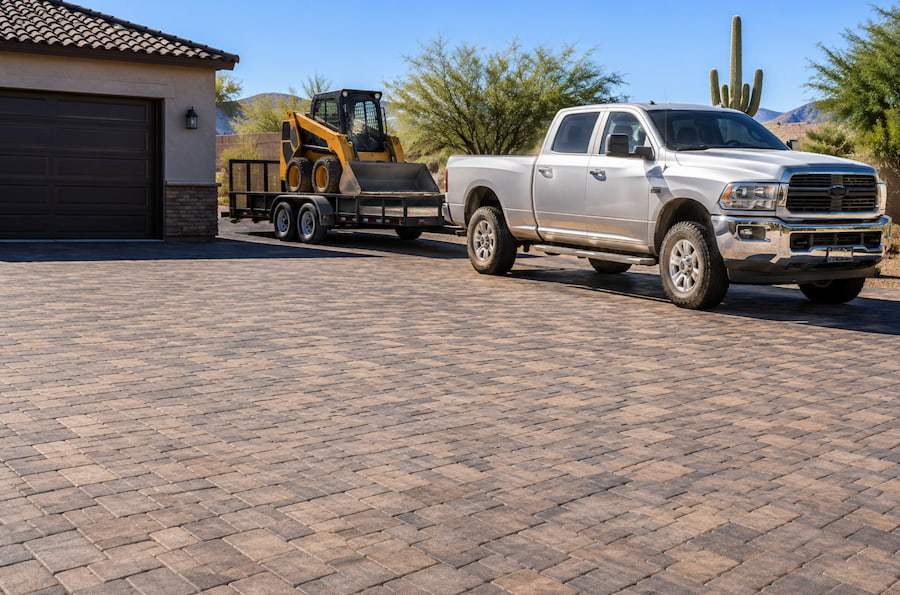
Upgrading Cracked Concrete and Asphalt to Vehicular Paver Driveways
Situations where Buckeye homeowners and business owners request this specialized masonry work:
Across Buckeye, Tartesso, Verrado, and the greater West Valley, homeowners and commercial property developers frequently contact our crews when addressing changing property conditions, grade transitions, boundary security requirements, and outdoor living upgrades. Whether resolving steep yard elevation drops, building secure perimeter walls around swimming pools, or renovating weathered surfaces that no longer meet HOA standards, timely professional masonry ensures long-term structural protection.
Every property presents distinct physical demands. We systematically evaluate soil bearing capacity, property boundary pins, neighbor setbacks, and existing utility easements before designing the installation. By addressing underlying earth pressures, storm runoff flows, and local municipal standards up front, we deliver durable masonry and hardscape installations engineered to stand firm for decades.
Why Heavy Trucks and Desert Heat Destroy Standard Concrete Driveways
Specific soil, temperature, and atmospheric pressures unique to Maricopa County and the Sonoran Desert:
The Sonoran Desert environment subjects exterior masonry and hardscaping to exceptional physical stress. Extreme summer surface temperatures exceeding 140°F induce rapid thermal expansion across concrete, stone, and mortar assemblies, followed by swift nocturnal cooling that drives cyclic tension cracking. When unreinforced masonry panels lack expansion joints or proper footing embedment, this continuous thermal movement produces progressive joint separation and structural shear fractures.
Subsurface soil dynamics compound these environmental challenges. Buckeye sits on dense caliche hardpan and reactive expansive clays that swell dramatically when saturated by sudden summer monsoon downpours and shrink as they desiccate. Trapped hydrostatic water without engineered gravel backfills and perforated drain outlets multiplies lateral earth pressure behind walls, while unsealed footings experience differential upheaval that causes visible tilting, bowing, and foundation failure.
Paver Driveway Installation Standards
Built to withstand daily vehicle traffic, large SUVs, and Arizona heat without oil staining or rutting:
10,000 PSI Compressive Strength
High-density concrete paver units far exceeding standard residential driveway concrete ratings.
Non-Warping Interlock Design
45° herringbone paver orientation that locks units together under rotational steering forces.
Full Heavy Vehicle Rating
Engineered sub-base easily supporting multi-axle RVs, delivery box trucks, and large utility trailers.
Individual Unit Replaceability
Accidentally oil-stained or damaged pavers can be plucked and replaced in minutes without patching.
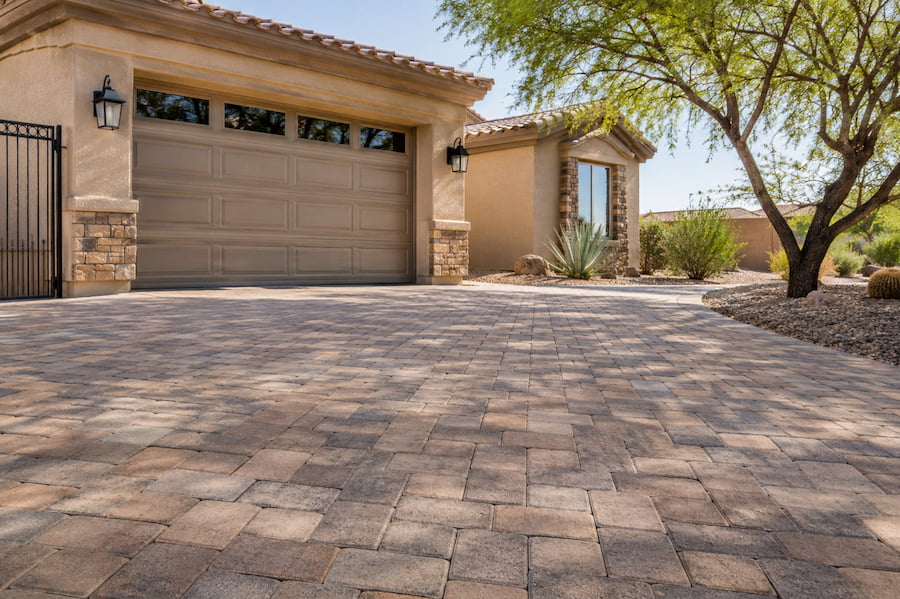
High-Strength Pavers, Road Base & Polymeric Sand
We install 80mm thick concrete pavers rated at 8,000+ PSI compressive strength over heavy aggregate road base designed to support full-sized trucks, SUVs, and motorhomes.
80mm Paver Thickness, Class II ABC Road Base, and Concrete Soldier Edges
Base Depth for Driveways
A paver driveway needs at least 6 inches of compacted crushed aggregate base, compared to 4 inches for a patio. The extra base carries the weight of vehicles without settling.
Edge Restraints Are Non-Negotiable
Without locked edge restraints, pavers at the edges spread outward under vehicle weight, opening gaps and ruining the driveway. We spike concrete or aluminum restraints into the base.
Paver Strength Rating
Driveway pavers must be rated for vehicular traffic, typically 8,000+ PSI compressive strength. Patio pavers are not strong enough and will crack under a vehicle load.
Geotextile Fabric
We lay geotextile fabric between the subgrade soil and the aggregate base. It stops the soil and the base from mixing, which would otherwise cause the base to sink into the ground.
Constructing Heavy-Duty Interlocking Paver Driveways
Excavation & Fabric
Excavating to 6+ inches and laying geotextile fabric on the subgrade.
Base Compaction
Installing and compacting crushed aggregate in tested layers.
Paver Laying
Setting vehicular-rated pavers in your chosen pattern.
Restraints & Sand
Spiking edge restraints and locking joints with polymeric sand.
Engineering Interlocking Paver Driveways for Arizona Vehicles
Why Paver Driveways Beat Concrete in Arizona
Concrete driveways are common in Arizona because they are cheap and fast to pour. But they have a fundamental flaw in our soil and climate. Concrete is a rigid slab. When the ground underneath moves, and in Buckeye it does move, the slab cannot flex. It cracks. Every concrete driveway in Buckeye has cracks, and they only get worse over time.
Pavers are different. They are individual units laid on a flexible base. When the ground shifts, the pavers shift with it, staying flat and interlocked. They do not crack because there is no rigid slab to crack. If the ground settles and a few pavers dip, you lift them, add base material, and reset them. The driveway is repairable in a way concrete never is.
Pavers also handle heat better. Concrete expands and contracts with temperature, which contributes to cracking. Pavers have joints between every unit that absorb that movement. In a climate where the surface temperature of a driveway can hit 150 degrees in summer, that flexibility matters. A paver driveway is simply better suited to Arizona than a concrete slab.
The Base Is Everything
The pavers you see are only the top layer. What makes a paver driveway hold up under a truck or an RV is the base underneath. A driveway base is not the same as a patio base. It has to be deeper, more compacted, and separated from the soil with fabric, or it will sink.
We excavate to at least 6 inches below the pavers and lay geotextile fabric on the subgrade. The fabric stops the soil and the aggregate from mixing. Without it, the aggregate base slowly sinks into the soil, and the driveway develops dips. On top of the fabric, we install and compact crushed aggregate in layers, testing the compaction as we go.
The base is compacted to a density that will not settle further under load. This is the step that gets skipped on cheap installations. A base that is not properly compacted will sink under the weight of a vehicle, and the pavers on top will sink with it. A deep, compacted, fabric-separated base is the difference between a driveway that lasts 30 years and one that dips in 3.
Edge Restraints and Joint Sand
Two things keep pavers from spreading and coming loose: edge restraints and joint sand. Edge restraints are the borders that run along the sides of the driveway, locking the pavers in place. Without them, the pavers at the edges push outward under vehicle weight, and gaps open up. The whole field starts to loosen.
We install concrete or aluminum edge restraints, spiked into the compacted base, along every open edge of the driveway. These restraints are buried so you do not see them, but they hold the entire field tight. They are non-negotiable on a driveway. Any paver driveway without locked edge restraints will fail at the edges.
Joint sand is the other half. We sweep polymeric sand into the joints, then activate it with water. The sand hardens, locking the pavers together and sealing the joints against washout. Plain sand washes out in monsoon rains, leaving pavers loose. Polymeric sand stays put, keeps weeds out, and keeps the pavers interlocked. It is the detail that makes the driveway solid underfoot.
Choosing the Right Paver for a Driveway
Not every paver is rated for a driveway. Patio pavers are thinner and weaker, and they will crack under the weight of a vehicle. Driveway pavers are thicker, denser, and rated for vehicular traffic, typically 8,000 PSI or higher. We only use pavers rated for the load they will carry.
Concrete driveway pavers are the standard. They are strong, come in many colors and patterns, and are cost-effective. For a higher-end look, porcelain pavers are an option. They are extremely dense, absorb almost no water, resist stains, and look like natural stone. They cost more but give a premium finish that does not fade.
The color matters in Arizona. Dark pavers absorb heat and get hot. Light or medium tones stay cooler and hide dust better, which matters in a dusty desert environment. We help you pick a paver that is rated for the load, fits your home, and handles the sun. The right paver, on the right base, with the right restraints, gives you a driveway that looks great and lasts for decades.
What Determines Paver Driveway Installation Costs
Driveway square footage, excavation depth through desert caliche, existing asphalt or concrete removal, and RV pad expansion affect the overall project investment:
Related Concrete & Masonry Services
Why Trust Our Paver Driveway Specialists in Buckeye
A driveway takes far more abuse than a patio or walkway. We engineer deep sub-bases and commercial-grade concrete edge restraints so your driveway never ruts or spreads.
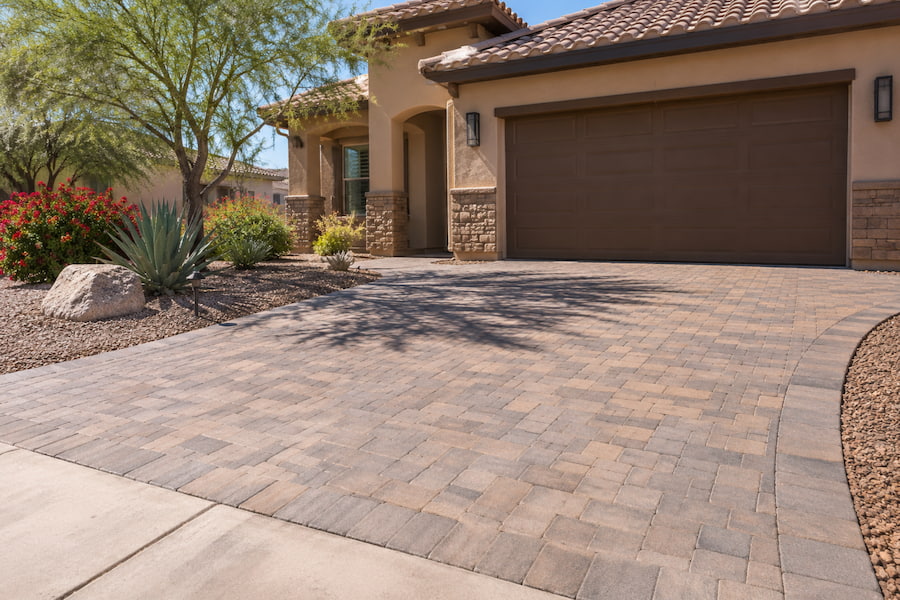
Frequently Asked Questions About Paver Driveways in Buckeye, AZ
Practical, straightforward answers about costs, permits, repairs, and desert construction.
Q1.Are paver driveways strong enough for heavy vehicles in Buckeye, AZ?
Yes, when built on a 6+ inch compacted base with vehicular-rated pavers (8,000+ PSI), a paver driveway handles trucks, RVs, and trailers without issue.
Q2.How long does a paver driveway last in Buckeye, AZ?
A properly installed paver driveway lasts 30 to 50 years. The pavers themselves can last even longer, and any settled paver can be lifted and reset individually.
Q3.Do paver driveways crack like concrete in Buckeye, AZ?
No. Pavers are individual units that flex with the ground. They do not crack like a rigid concrete slab. If one settles, it can be reset without replacing the driveway.
Q4.How much does a paver driveway cost in Buckeye, AZ?
A paver driveway typically runs $12 to $25 per square foot installed, depending on the paver selection, base depth, and site preparation required.
Q5.Can you install a paver driveway over my old concrete in Buckeye, AZ?
Only if the concrete is sound and properly sloped. In most cases, we remove the old concrete and build a fresh base, which gives a longer-lasting result.
Q6.Do paver driveways get hot in the summer?
Darker pavers absorb heat. Light or medium-tone pavers stay cooler and are a better choice for a driveway in full desert sun.
Q7.How long does paver driveway installation take?
A standard two-car driveway takes about 3 to 5 working days from excavation to final joint sand locking.
Q8.Are paver driveways warrantied?
Yes, all our paver driveway installations are backed by our Arizona ROC #354592 license and warranty coverage.
Ready to Build or Repair Your Paver Driveway Installation?
Schedule an on-site consultation in Buckeye or anywhere in the West Valley for a clear, itemized proposal.