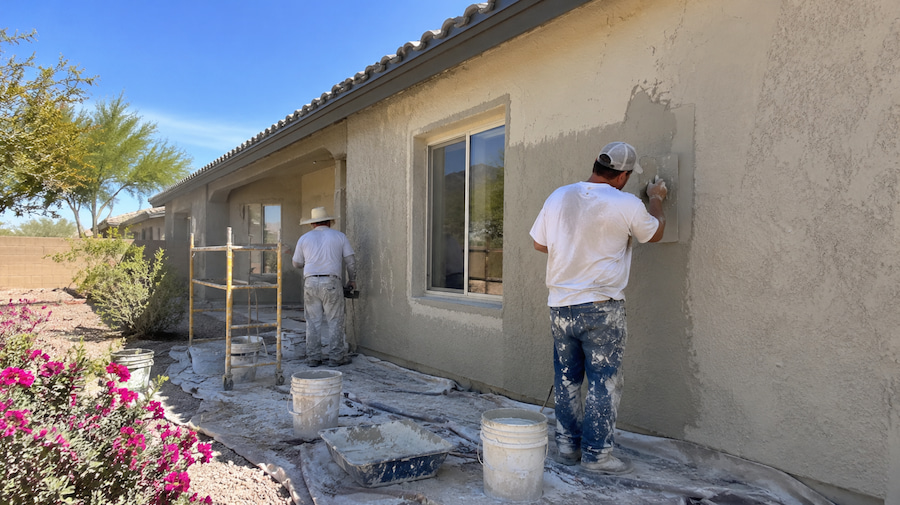
Stucco Installation & Finishing in Buckeye, Arizona That Gives Exterior Walls a Fresh Look
Transform utilitarian concrete block walls into elegant, architectural home enclosures with traditional three-coat and acrylic synthetic stucco finishes.
Pricing Provided by Block Guys LLC
Stucco is what turns a raw grey block wall into a finished part of your home. It is a cement-based plaster applied over the block that creates a smooth, continuous surface you can paint or leave in its natural color. In Buckeye, stucco is the standard finish for perimeter and privacy walls because it matches the look of the homes and protects the block underneath.
Done well, stucco lasts for decades and needs almost no maintenance. Done poorly, it cracks, bubbles, and pulls away from the wall within a few years. The difference is almost entirely in the preparation and the application. Stucco needs a clean, bonded surface, the right mix, and proper curing. Skip any of those and the finish fails.
Buckeye Block Wall Contractors installs and finishes stucco on new and existing block walls across the West Valley. We do traditional three-coat cement stucco and modern acrylic synthetic finishes. We match the textures and colors that Buckeye HOAs require, and we repair stucco that is delaminating or cracking on older walls.
How Stucco Installation & Finishing Works and Why It Matters
We handle metal lath installation, scratch and brown coat application, and custom texture coats that match your home's exterior and comply with all Buckeye HOA architectural guidelines.
Every stucco installation & finishing project we take on in Buckeye and the surrounding West Valley is treated as a complete build, not a quick patch. That means we handle the full scope from the ground up. Excavation, base preparation, structural reinforcement, and the final finish are all part of the same coordinated effort. You are never left coordinating multiple trades or guessing what comes next.
We start by walking your property with you. We listen to what you want the finished wall or outdoor space to accomplish. Then we point out conditions that could affect the build. Desert soil, drainage paths, property slopes, and neighboring structures all factor into how we plan the work. You get a clear explanation of what we will do, why we will do it that way, and what you can expect at each stage.
Materials are selected for Arizona conditions. We use high-strength block, properly graded aggregate base, Grade 60 steel reinforcement, and mortar mixed for hot-weather placement. Nothing is substituted to save a few dollars, because the desert punishes shortcuts. A wall or hardscape built right the first time saves you from costly repairs down the road.
Bonding Agents, Scratch Coats,
& Desert-Grade Acrylic Color Textures.
Applying stucco over Buckeye CMU requires proper surface prep, bonding adhesives, and multi-coat curing routines designed to prevent hairline cracking in dry desert air.
Substrate Pre-Wet & Bond Adhesives
Moistening porous block units and rolling high-strength acrylic bonder to ensure scratch coat adhesion.
Fiber-Reinforced Base Coats
Cementitious scratch and brown coats blended with synthetic microfibers to arrest shrink-cracking during curing.
Controlled Moisture Curing
Systematic misting schedules over 48 hours to maintain hydraulic hydration in low-humidity conditions.
Hand-Applied Textures
Expert application of authentic sand float, Santa Barbara smooth, lace, or dash finishes matching local architecture.
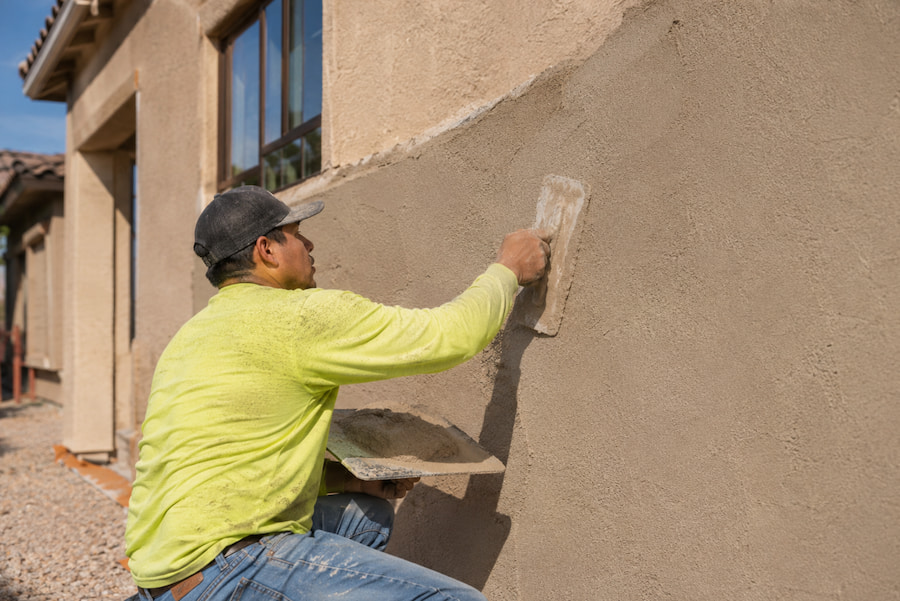
When Your Block Walls Need New Stucco or Surface Repairs
Situations where Buckeye homeowners and business owners request this specialized masonry work:
Across Buckeye, Tartesso, Verrado, and the greater West Valley, homeowners and commercial property developers frequently contact our crews when addressing changing property conditions, grade transitions, boundary security requirements, and outdoor living upgrades. Whether resolving steep yard elevation drops, building secure perimeter walls around swimming pools, or renovating weathered surfaces that no longer meet HOA standards, timely professional masonry ensures long-term structural protection.
Every property presents distinct physical demands. We systematically evaluate soil bearing capacity, property boundary pins, neighbor setbacks, and existing utility easements before designing the installation. By addressing underlying earth pressures, storm runoff flows, and local municipal standards up front, we deliver durable masonry and hardscape installations engineered to stand firm for decades.
What Causes Stucco to Crack, Bubble, or Lose Its Bond
Specific soil, temperature, and atmospheric pressures unique to Maricopa County and the Sonoran Desert:
The Sonoran Desert environment subjects exterior masonry and hardscaping to exceptional physical stress. Extreme summer surface temperatures exceeding 140°F induce rapid thermal expansion across concrete, stone, and mortar assemblies, followed by swift nocturnal cooling that drives cyclic tension cracking. When unreinforced masonry panels lack expansion joints or proper footing embedment, this continuous thermal movement produces progressive joint separation and structural shear fractures.
Subsurface soil dynamics compound these environmental challenges. Buckeye sits on dense caliche hardpan and reactive expansive clays that swell dramatically when saturated by sudden summer monsoon downpours and shrink as they desiccate. Trapped hydrostatic water without engineered gravel backfills and perforated drain outlets multiplies lateral earth pressure behind walls, while unsealed footings experience differential upheaval that causes visible tilting, bowing, and foundation failure.
Stucco Installation & Finishing Standards
From bare cinder block to flawless architectural finish, our plastering teams follow precise standards:
ASTM C926 Formulation
Strict cement-to-aggregate proportions ensuring uniform compressive strength and thermal stability.
Integrated Corner Beads
Corrosion-proof PVC or zinc alloy external corners ensuring crisp, impact-resistant vertical wall returns.
Full 7/8-Inch System Depth
Standard three-coat or two-coat direct CMU application reaching maximum fire and impact protection.
100% Integral Color Mix
Mineral oxide pigments blended directly into finish coats so minor chips never reveal bare grey plaster.
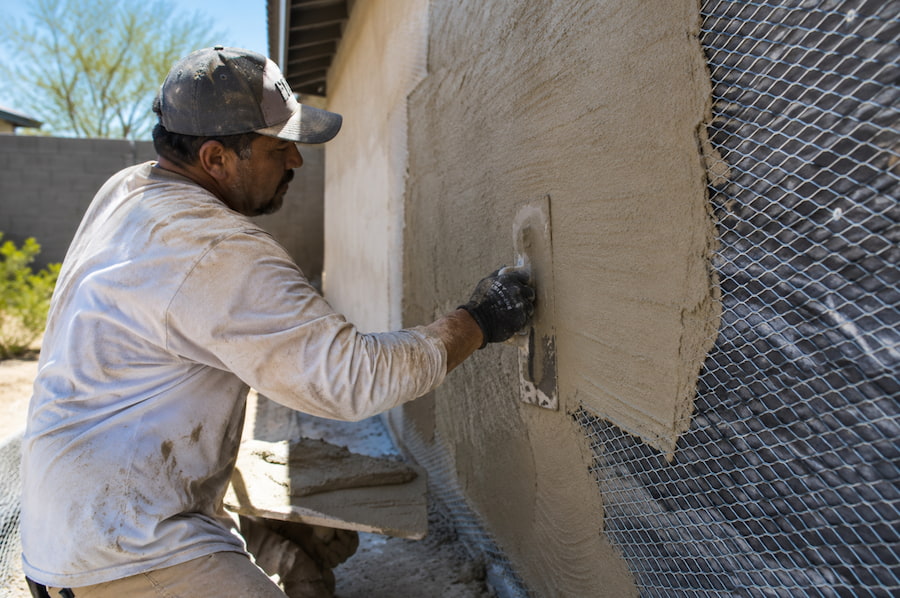
Plastering Compounds, Lath & Finish Coats
We use Portland cement plaster bases combined with elastomeric acrylic topcoats to provide maximum crack resistance against severe Arizona desert temperature swings and direct solar heat.
Stucco Base Coats, Bonding Methods, and Expansion Control
Three-Coat Stucco System
Traditional stucco uses a scratch coat for grip, a brown coat for thickness and flatness, and a finish coat for texture and color. Each layer must cure properly before the next goes on.
Acrylic Synthetic Finishes
Acrylic finish coats use polymer resins instead of cement. They are more flexible, resist hairline cracking better, and come pre-colored, which makes them popular for Arizona walls.
Bonding to Concrete Block
Stucco bonds best to clean, damp masonry. We apply an acrylic bonding agent and mist the wall so the scratch coat does not lose its water to dry block before it cures.
Control Joints for Thermal Movement
Stucco moves with the wall. We place control joints at intervals so the inevitable movement happens in planned lines, not as random cracks across the face.
How Stucco Base Coats and Finishes Are Applied
Bonding Prep
Wetting masonry and rolling acrylic bonding adhesive.
Base Coat
Applying fiber-reinforced base cementitious coat.
Finish Texture
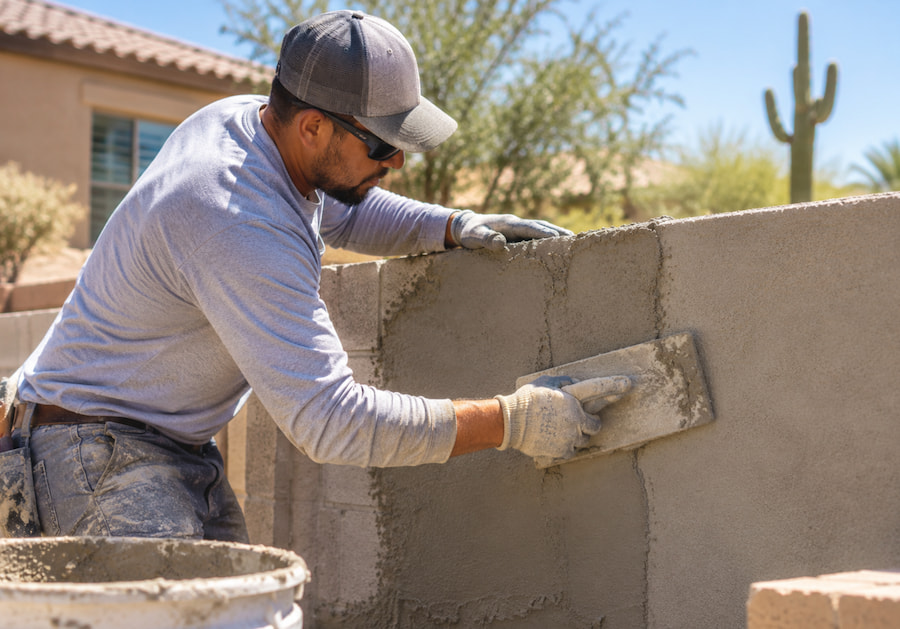
Hand-troweling your selected architectural texture.
Cure & Seal
Controlled hydration curing to achieve maximum durability.
Understanding Stucco Systems for Arizona Masonry
How Stucco Actually Bonds to a Block Wall
Stucco does not just sit on top of a block wall. It has to bond to it. The scratch coat, the first layer, is worked into the surface of the block so it grabs hold. On a clean, properly dampened block wall, that bond is strong and permanent. On a dusty, dry, or painted wall, the stucco has nothing to grab, and it eventually delaminates and falls off.
This is why preparation matters so much. We clean the wall, apply an acrylic bonding agent, and mist the surface with water before the scratch coat goes on. The bonding agent creates a chemical bridge between the cement and the block. The misting keeps the dry block from sucking the water out of the wet stucco, which would weaken the cure.
On framed structures or surfaces that are not masonry, we install galvanized wire lath first. The lath gives the stucco a mechanical grip instead of a chemical one. Either way, the goal is the same. The stucco becomes part of the wall, not a layer resting on top of it.
Choosing a Texture: Sand Float, Lace, Dash, or Smooth
The texture is the visible part of stucco, and it is largely a matter of style and HOA rules. Sand float is the most common finish in Buckeye. It has a uniform, slightly rough surface that hides minor imperfections and matches most subdivision walls. Spanish lace has a more decorative, hand-swept pattern. Dash is a rougher, splattered texture. Smooth finish is the hardest to do well because it shows every trowel mark.
Sand float in a 16/20 or 20/30 grit is what most Buckeye homeowners choose because it matches their home's exterior and meets HOA standards. It is also the most forgiving texture to apply, which keeps the cost reasonable.
The finish coat can be left natural grey, integrally colored with pigment, or painted after curing. Acrylic synthetic finishes come pre-colored and skip the painting step. They also flex more than cement stucco, which helps in our climate of big temperature swings.
Why Stucco Cracks and How We Prevent It
Stucco is rigid, but the wall underneath it moves. Desert temperature swings from cool nights to hot days make the block expand and contract. If the stucco has no way to accommodate that movement, it cracks. Some hairline cracking is normal in any stucco wall, but wide or patterned cracks mean the wall is moving more than it should.
We control this two ways. First, we install control joints at planned intervals. These are deliberate lines that concentrate movement where we want it, instead of letting random cracks form across the face. Second, we use acrylic finish coats where extra flexibility is needed, because acrylic stretches where cement would crack.
If the wall itself is moving because of a footing problem, no stucco will hold. That is why we look at the whole wall, not just the surface. Fixing the structure first, then finishing it, is the only way to get a stucco finish that stays put.
Repairing Stucco That Is Bubbling or Pulling Away
When stucco starts to sound hollow when you tap it, or when it bubbles and pulls away from the wall, it has lost its bond. This is called delamination. It usually happens because the original stucco was applied over a dirty or dry surface, or because water got behind it and broke the bond.
We repair delamination by cutting out the hollow area down to solid block, cleaning the surface, applying a bonding agent, and applying new stucco in layers that match the surrounding texture and color. A good patch is invisible once it cures and is painted.
The key is removing all of the loose stucco, not just the obviously bubbled part. If we leave a hollow edge, the repair will fail at that edge. We cut back to where the stucco is solid and bonded, then build back out.
What Determines Stucco Application & Finishing Costs
Surface square footage, substrate condition, texture style (sand float, lace, dash, or smooth Santa Barbara), and scaffolding requirements shape your stucco finishing quote:
Related Concrete & Masonry Services
Why Buckeye Homeowners Trust Us for Stucco Finishing
Stucco work demands seamless blending and strict curing schedules under desert heat. Our plasterers bring decades of field experience to protect and beautify your property.
Frequently Asked Questions About Stucco Finishing in Buckeye, AZ
Practical, straightforward answers about costs, permits, repairs, and desert construction.
Q1.Can stucco be applied directly over concrete block walls in Buckeye, AZ?
Yes, when an approved acrylic bonding agent is applied, base coat stucco bonds tenaciously to clean concrete masonry block.
Q2.What stucco textures are most popular in Buckeye, AZ?
Sand float (16/20 or 20/30 grit) and subtle Spanish lace are the two most common textures matching Buckeye residential subdivisions.
Q3.Can you fix bubbling or peeling stucco on my block wall in Buckeye, AZ?
Yes, we chip away hollow, delaminated stucco down to solid masonry, re-apply bonding primer, and feather-in fresh stucco.
Q4.Does stucco make block walls last longer in Buckeye, AZ?
Yes, stucco shields porous CMU blocks and mortar joints from direct sun exposure and rain penetration.
Q5.What is acrylic synthetic stucco in Buckeye, AZ?
Acrylic stucco uses 100% acrylic polymers with integral color, providing superior flexibility and resistance to hairline cracking.
Q6.How long does stucco take to dry heat?
In Buckeye's climate, base coats cure within 48 to 72 hours with proper moisture misting to prevent rapid dehydration.
Q7.How much does block wall stucco cost?
Typically, block wall stucco finishing ranges between $3.50 and $7.00 per square foot depending on texture and acrylic options.
Q8.Can you match my house stucco color exactly?
Yes, we take physical stucco chips or HOA paint formula codes to ensure a virtually undetectable match.
Ready to Build or Repair Your Stucco Installation & Finishing?
Schedule an on-site consultation in Buckeye or anywhere in the West Valley for a clear, itemized proposal.